Get Full Government Meeting Transcripts, Videos, & Alerts Forever!
Get email alerts on the Contracts topic
No spam. Unsubscribe anytime.
Council, contractor and counsel spar over 15-year solid-waste contract terms; council directs staff to return with clarifications
Summary
A detailed presentation and multi-hour council exchange covered a proposed 15-year solid-waste contract including a rolling 15‑year term, a $25,000 performance-fee threshold for termination, rate‑adjustment mechanics, and the legality of nonprofit discounts; council requested follow-up information and did not finalize a vote.
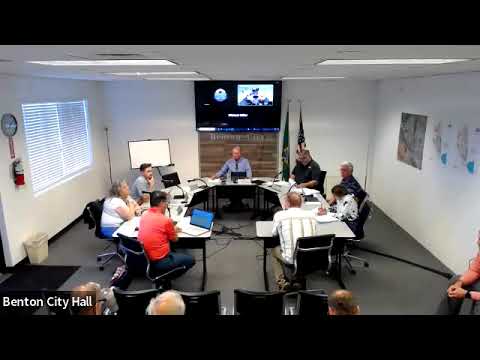
Benton City councilors spent a large portion of the June 2 meeting on a proposed solid‑waste and disposal agreement presented by the contractor. The exchange covered term length and automatic extensions, performance fees and default remedies, rate adjustments and pass‑throughs, curbside recycling requirements, transfer‑station nonresident fees, and whether the city may subsidize service for nonprofits.
Term, notice and extensions: staff and the contractor read the contract's term provisions aloud. The agreement included a 15‑year base term with automatic one‑year extensions unless either party gives written termination notice 90 days prior to each anniversary. Staff and council members asked whether other termination provisions (for default or cause) would override the rolling extension; staff said the contract contains separate default/termination language giving the city a 30‑day cure period for material breach.
Performance fees and termination threshold: council raised a concern that Section 7.1 treats certain operational failures as subject only to per‑incident fines (for example, $50 per missed collection incident) and then states that the city may not terminate the agreement under that section unless performance fees exceed $25,000 each month for three consecutive months. Counsel noted that the clause could create a high bar to reach termination under that particular remedy schedule. "That was the danger...that, would never be able to be met because there's only 2 trucks in the city for a week or something like that," staff said, noting the figure could make termination for breaches impractical; the contractor said the city retains other default remedies under Section 7.2.
Rate adjustments and pass-throughs: the contractor explained multiple adjustment mechanisms (annual base rate adjustments, disposal/tipping pass-throughs, fuel surcharges and a "walkout" adjustment triggered when disposal volume changes more than 5%). Council asked how households would be affected and whether nonresident users at the transfer station would be charged separately to avoid subsidies by residents.
Nonprofit discounts and gifting concerns: city counsel warned that providing discounted service to nonprofits could run afoul of state rules against gifting public funds unless the city can show a public benefit or use a separate funding mechanism. Counsel suggested any program to assist nonprofits might be implemented outside the disposal agreement as an explicit city funding program with eligibility rules.
Outcome: council did not finalize a contract vote. Instead the council directed staff and the contractor to return with detailed answers to specific questions (clarify the $25,000 threshold and termination interplay, confirm the practical operation of volume and rate adjustments, provide examples of how nonresident fees would be charged at the transfer station, and outline options for nonprofit support outside the contract). The contractor agreed to return with information for the next meeting.