Get Full Government Meeting Transcripts, Videos, & Alerts Forever!
Get email alerts on the Surveillance Contracts topic
No spam. Unsubscribe anytime.
Dunwoody council defers Flock OS 9-1-1 contract after hours of public concern and technical review
Summary
After an extended public-comment period and a staff presentation of a security assessment, Dunwoody's City Council voted unanimously to defer consideration of the Flock OS 9-1-1 contract to April 13 while a new master services agreement (MSA) is finalized and additional audit/notification measures are negotiated.
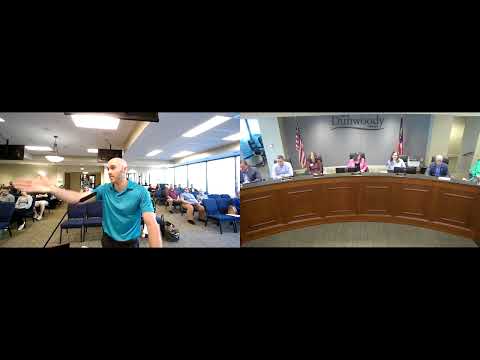
Dunwoody's City Council on March 23 unanimously voted to postpone action on a proposed contract for Flock OS 9-1-1 until its April 13 meeting while the city finalizes a master services agreement and tightens contractual language on breaches, data use and audits.
Council took the step after a lengthy public-comment session in which residents, security researchers and labor representatives sharply criticized the vendor's data-sharing model, cited documented configuration and camera-access problems, and urged the city not to expand or renew surveillance contracts. Isaac, a Kennesaw State University student, said Flock's recent software behavior raised concerns that the vendor could detect voices despite prior assurances and flagged inconsistent retention claims. Ben Jordan, a researcher, recounted published security findings and urged an independent security and ethics audit before further contracting.
City outside counsel Jill Dunn told the council staff had been negotiating a single master services agreement intended to replace and consolidate the city's existing Flock orders. Dunn said the MSA would "freeze" any vendor web terms in effect at signature, subordinate those web terms to the negotiated contract, and add clearer breach, notice and data-ownership provisions. She said a draft should be available in roughly 7–10 days.
Ginger LePage, who led the city's technical review, summarized a color-coded security matrix that assessed governance/CJIS alignment, retention and legal-hold controls, data protection and tenancy isolation, user access and multifactor authentication, audit logging, operational resilience and privacy/compliance. LePage said many controls exist or are described, but supporting evidence was missing in several categories and some items were marked for increased oversight, training and policy updates. She recommended monthly auditing and contract provisions that would require real-time notification when external agencies access Dunwoody's data.
Dan Haley, Flock's chief legal officer, told the council the vendor's contract allows use of a very small, de-identified sample ("less than 1%") of images to improve system accuracy and that the company strips metadata to prevent reidentification; he said the company had not shown systemic customer-data breaches. Major Patrick Creed of Dunwoody Police described retention practices: license-plate detections are generally deleted after 30 days unless preserved for an investigation, while drone footage is kept 180 days unless saved for evidence.
The council pressed staff and the vendor on three recurring points: a precise contractual definition of a data "breach" and mandatory notification; real-time alerts when outside agencies access Dunwoody data; and stronger, more frequent independent audits of system use and sharing relationships. Dunn said those issues were being addressed in the MSA negotiations.
After staff recommended delaying formal approval until the MSA was complete, Councilmember Stacy moved to defer consideration of the Flock OS 9-1-1 contract to April 13; the motion was seconded by Rob and passed unanimously. The council and staff said Flock OS 9-1-1 would continue operating during the deferral and the administration would return with the draft MSA and any proposed contract provisions.
Why it matters: license-plate reader networks and vendor-hosted sharing ecosystems raise both crime-solving benefits and privacy/security risks. Dunwoody's decision to pause the contract gives staff time to convert vendor promises into enforceable contract terms, to add notification and audit mechanisms, and (per public requests) to consider independent security verification before committing new, long-term terms.
What's next: staff expects the MSA draft within about 7–10 days and will return to council with the negotiated contract and any recommended audit and access controls on or before the April 13 meeting, when council will reconsider the Flock OS 9-1-1 matter.
Attribution: Many direct quotes and technical descriptions in this report come from public commenters and staff during the March 23 Dunwoody City Council meeting. Public commenters who spoke against the contract included Isaac (student, Kennesaw State University), Taylor (resident, Powder Springs), Ben Jordan (security researcher), and a large group of residents and advocates; staff presenting the review included Jill Dunn (outside counsel) and Ginger LePage (city IT/real-time center). Flock was represented on Zoom by Dan Haley, chief legal officer.