Get Full Government Meeting Transcripts, Videos, & Alerts Forever!
Get email alerts on the Criminal Justice Technology topic
No spam. Unsubscribe anytime.
NIJ opens two FY25 research NOFOs for AI and law‑enforcement technology; concept papers due June 15
Summary
The National Institute of Justice on May 14 published two FY25 notices of funding opportunity—one on artificial intelligence for criminal justice and one on research and evaluation of emerging technology implementation for law enforcement—and will accept 30‑day concept papers through June 15; invited applicants may submit full proposals later in the year.
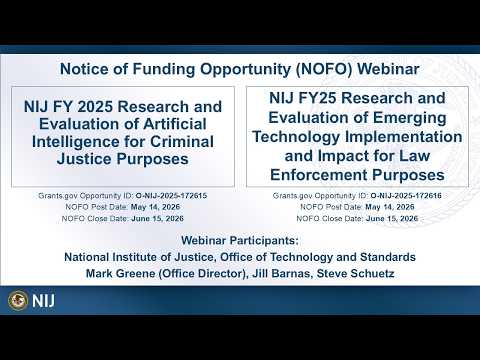
The National Institute of Justice on May 14 launched two FY25 funding opportunities seeking applied research on artificial intelligence in criminal justice and on technology implementations for law enforcement, agency officials said during a webinar for prospective applicants.
Mark Green, director of NIJ’s Office of Technology and Standards, told attendees that both NOFOs follow a two‑phase process: a short concept paper (the screening step) and an invited full proposal. "Both of these were published on May 14, and they're gonna close on June 15," Green said, urging applicants to register early on SAM.gov and grants.gov and to upload concept packages to DOJ’s JustGrants system.
Why it matters: NIJ described the NOFOs as applied‑research grants meant to inform practice. The agency emphasized that projects should pair rigorous evaluation with any technology implementation so results are usable by practitioners and policymakers.
The AI NOFO, presented by Jill Barnas, seeks studies that "enhance the effectiveness of AI in criminal justice and address potential risks," including research to evaluate existing systems, test methodologies and assess outcomes when AI is integrated into practice, Barnas said. The technology NOFO, presented by Steve Schutz, covers evaluations of emerging tools such as small unmanned aircraft systems and AI‑enabled threat detection integrated with existing security infrastructure.
Application basics and format: NIJ said concept papers should include a cover page, a four‑page project narrative, a one‑page statement of applicant capabilities (biosketch/capabilities), and a one‑page budget sketch. Applicants must also submit the SF‑424 (Application for Federal Assistance). NIJ will screen concept papers for basic minimum requirements and responsiveness, then score three components (narrative, budget sketch, biosketch) on a 0–4 scale and sum them for a 0–12 total. The highest‑scoring concept papers will be invited to submit full proposals, which NIJ expects to merit‑review externally.
Budget and award guidance: NIJ told attendees that concept‑stage budgets can be high‑level "order of magnitude" sketches that indicate major cost categories (personnel, equipment, travel) and an anticipated year‑by‑year breakdown when possible. The agency said projects may run up to five years and that equipment purchases are allowable, but applicants should balance purchase costs with a rigorous evaluation plan. NIJ also pointed applicants to the DOJ Financial Guide and 2 CFR part 200 for indirect cost rules and noted the 10% de minimis option where applicable.
Selection and timing: NIJ staff said they hope to issue invitations to submit full proposals roughly one month after the concept‑paper window closes; applicants typically will have about 30 days to assemble a full application in JustGrants. Final funding decisions are made by the NIJ director, and award notices will be posted on the Office of Justice Programs site.
Questions and compliance: NIJ fielded audience questions on scope (including whether audits, alternative solutions, or RF/signal applications qualify), compliance with immigration‑related statutory requirements, and the expected level of economic analysis in proposals. For specific compliance or scope questions, NIJ directed applicants to submit inquiries to the OJP Response Center email provided in the NOFO.
Next step: interested applicants should consult the full NOFO documents on grants.gov and NIJ’s website for eligibility details, program descriptions and the OJP contact information; concept papers must be submitted through grants.gov and uploaded to JustGrants prior to the June 15, 11:59 p.m. deadline.