Get Full Government Meeting Transcripts, Videos, & Alerts Forever!
Get email alerts on the Housing Rentals topic
No spam. Unsubscribe anytime.
Bellingham planning committee asks staff to explore tenant survey after 2025 landlord study
Summary
The Bellingham City Council planning committee voted to ask staff to research methods for surveying tenants and to explore a follow-up landlord survey after reviewing the 2025 landlord and property manager survey, noting differences between 'mom-and-pop' landlords and larger property managers.
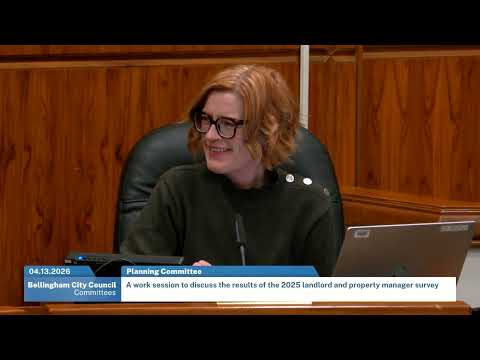
The Bellingham City Council's planning committee met March 9, 2026, to review results of the 2025 landlord and property manager survey and voted to ask city staff to investigate options for surveying tenants as well as to study a follow-up landlord survey.
Council member Huffman, who chairs the planning committee, opened the work session and said the item was an opportunity for council members to discuss results that staff previously presented at the March 9 regular council meeting. Legislative policy analyst Iris Knott summarized the packet, noting supplemental graphs and a separate “mom and pop” subgroup (owners of a single unit managed by the owner, a friend, or a relative) created to compare responses.
Knott said the headline quantitative finding was that overall proportions were similar across landlord types but differed by magnitude. For example, 11% of all landlords reported changing their pet policies, compared with 6% among the mom-and-pop subgroup. Knott also emphasized that open-ended comments — excluded from the condensed charts — included expressions of fear about being out of compliance and concerns about frequent regulatory changes, adding nuance to the numeric results.
Council members pressed staff on timing and outreach. Knott said the October mailing tied to the city’s annual rental registration notice provided a cost-effective way to reach landlords and that tenant outreach would require a different approach and more deliberate sampling and question design. Huffman moved that staff look into processes for obtaining similar information from tenants; Council member Anderson indicated support and was recorded as the second. The committee approved the motion by voice and Huffman said she would bring the request to the full council that evening.
Members also discussed whether to replicate the landlord survey in about a year to create a baseline for comparison. Council member Lo Loquist moved to accept staff’s recommendation to explore a follow-up landlord survey; the committee approved that request by voice vote and directed staff to return the item to the full council.
Council members raised related data priorities. Council member Cotton asked staff to consider tracking impacts on manufactured-home communities and residents; Anderson said that likely would require a separate survey because of different data needs and noted reports of rising space rent and displacement pressure. A staff member identified a forthcoming resolution to create a rental advisory group that could help craft questions and outreach for tenants and specialized housing groups.
Blake Lyon, director of planning and community development, announced two upcoming outreach events to help landlords and tenants learn about fair-housing law and rental regulations: a film and panel on April 22 and an informational session in the chambers on April 28; he directed attendees to the city website for details.
The committee treated the session as information and discussion only and took the two staff-direction votes described above; Huffman said both items would be brought to the full council that night for consideration. The committee then adjourned and returned control to the council president.