Get Full Government Meeting Transcripts, Videos, & Alerts Forever!
Get email alerts on the Domestic Violence Protection Orders topic
No spam. Unsubscribe anytime.
Susan Mark says high denial rates for temporary protection orders spurred judicial trainings and service expansions
Summary
Susan Mark, director of the Bellingham–Whatcom County Commission on Domestic Violence, told the council the commission’s review found a high denial rate for temporary protection orders and outlined planned judicial trainings, a restorative‑justice pilot, school workshops and a federal grant supporting advocacy and court training.
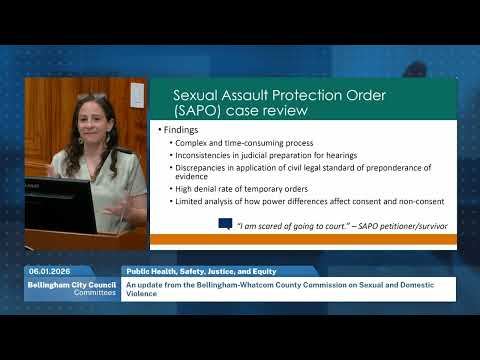
Susan Mark, director of the Bellingham–Whatcom County Commission on Domestic Violence, told the City Council committee that the commission’s recent case review revealed system gaps and a comparatively high denial rate for temporary protection orders, and outlined steps to address those problems.
The update, delivered to the public health, safety, justice and equity committee, explained that the commission — formed jointly by the City of Bellingham and Whatcom County in 1998 — receives $90,000 annually from each jurisdiction to support its work and also holds a Department of Justice Office on Violence Against Women grant totaling $600,000 over three years to fund staff, advocacy and trainings. "The grant we currently have is for $600,000 over 3 years," Mark said.
Why it matters: Mark said many petitioners apply pro se for civil protection orders in district court and face a complex, time‑consuming process. In its review the commission examined filings, dockets and recordings and found continuances, inconsistent judicial preparation and legal language that can be difficult for non‑lawyers to navigate. "We have a very high denial rate of temporary orders in this county," Mark said, a trend she said is higher than in neighboring counties.
What the commission proposes: Mark described a set of near‑term actions to improve outcomes, including a judicial training series this winter on the neurobiology of trauma and practical changes to hearing practices; developing a system for courts to appoint attorneys for pro se petitioners in civil protection cases; improving electronic communications between courts and petitioners; and strengthening language and disability access. "One thing that we haven't done in many years is having just a hearing for the temporary order... so they could actually ask questions if something isn't clearly represented in their writing," she said.
Program pilots and school work: The commission plans a restorative‑justice pilot to shepherd a single survivor‑centered case through facilitated restorative processes so it can document outcomes and seek funding for broader programming. It also described school engagement begun in 2025 — trauma‑informed workshops and a proposed community of practice for districts and private schools (three workshops per year) to support survivors and accountability for students who cause harm. Mark encouraged community feedback and noted the commission is coordinating judicial officers, superintendents and other partners to craft protection‑order language that can be enforced on school grounds while minimizing disruption to students' education.
Voices from the committee: Councilmembers praised the commission’s work. One councilmember said the commission's limited budget yields substantial systems change; another said restorative options expand community choices for accountability and healing.
Next steps: The commission will host judicial trainings funded by the DOJ grant, pilot a restorative‑justice case with existing facilitators, continue school workshops and seek additional sponsorships for its 2026 Missing and Murdered Indigenous Women and People summit. The committee accepted the update; no formal action was taken on these program items at the meeting.