Get Full Government Meeting Transcripts, Videos, & Alerts Forever!
Get email alerts on the Transportation Policy topic
No spam. Unsubscribe anytime.
Bellingham committee adopts 2025–29 commute trip reduction plan, sets 57% drive‑alone target and approves Smart Trips interlocal
Summary
The Public Works & Natural Resources Committee approved an ordinance adopting the city’s 2025–2029 Commute Trip Reduction (CTR) plan, amended the city target to a 57% drive‑alone rate, removed Silfab Solar from the affected-employer list, and recommended an interlocal agreement with the Whatcom Council of Governments to administer Smart Trips through Dec. 31, 2029.
The Public Works & Natural Resources Committee on Feb. 9 voted unanimously to recommend adoption of the City of Bellingham’s 2025–2029 Commute Trip Reduction (CTR) plan and to approve a local interlocal agreement with the Whatcom Council of Governments (WCOG) for administration of the Whatcom Smart Trips program.
Councilmember Lilloquist introduced the ordinance, saying it would adopt the four-year CTR plan and create a new chapter in the Bellingham Municipal Code to align the city with state requirements (packet cites RCW 78.15.400). Councilmember Tim Holman (introduced by the chair) explained the ordinance adopts the plan and updates how the city administers its duties as both a jurisdiction and an affected employer.
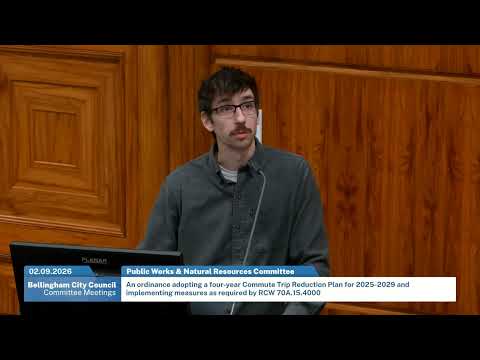
Dylan Casper, the city’s transportation planner, described the CTR program’s intent — to reduce congestion and air pollution by encouraging alternative commute modes through employer-based programs — and summarized which employers qualify as “affected” (sites with 100 or more full-time employees arriving regularly within the morning peak). He said the city has 15 affected employers (two voluntary) and that, rather than each employer running its own program, affected sites typically enroll in WCOG’s Smart Trips platform for trip logging, incentives and employer support.
Casper noted a version-control error in the packet: the regional drive-alone rate listed as 64% should be modified for the city to 57% to align with the city’s 2036 mode-shift goals. "We are proposing that that drive alone rate be 57% to fall in line with our... 2036 mode shift goals," Casper said. Councilmember Holman moved to amend the plan to reflect the 57% drive-alone target; the committee approved the amendment by voice. The committee also voted to strike Silfab Solar from the list of affected employers after staff confirmed Silfab is no longer operational in the city.
Lisa Anderson moved approval of the ordinance as amended; the committee voted by voice and the chair said he would forward a unanimous positive recommendation to the full City Council.
On a related item, the committee approved a motion recommending that the City enter an interlocal agreement with the Whatcom Council of Governments to designate WCOG as the lead agency to implement and administer the city’s CTR program via Whatcom Smart Trips. The recommended interlocal extends the WCOG contract term through Dec. 31, 2029 to align with the adopted CTR plan. Staff explained Smart Trips is one allowable pathway to meet CTR obligations; employers with an equivalent in-house program may follow another compliance pathway that meets state law.
The committee’s recommendations will be forwarded to the full council for final adoption and to execute the interlocal agreement.