Get Full Government Meeting Transcripts, Videos, & Alerts Forever!
Get email alerts on the Transportation Speed Limits topic
No spam. Unsubscribe anytime.
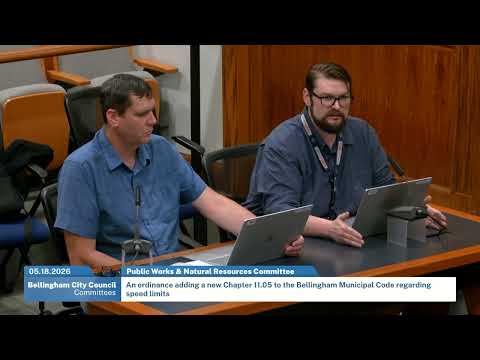
Bellingham committee backs ordinance to set default 20 mph on neighborhood streets
Summary
The Public Works & Natural Resources Committee unanimously recommended an ordinance to add chapter 11.05 to the Bellingham Municipal Code, establishing a default 20 mph limit on non‑arterial (residential) streets and codifying arterial speeds; staff were directed to work with WSDOT on an Old Fairhaven Parkway transition point.
The Public Works & Natural Resources Committee on Monday recommended approval of an ordinance that would set a citywide default speed limit of 20 miles per hour on non‑arterial (neighborhood and residential) streets and codify updated arterial speeds in the Bellingham Municipal Code. The committee voted to forward the ordinance with a unanimous recommendation.
Tim Hollman, assistant director for transportation in the Public Works Department, told the committee the change is rooted in safety: “The number 1 thing that you can do to enhance safety is to lower speed limits,” he said, stressing that slower limits have the greatest effect for vulnerable road users such as pedestrians and cyclists. Staff said the city developed a context‑sensitive speed‑setting tool (based on an adapted NACTO city‑limits methodology) and applied it across the street network to generate recommended limits.
Shane Sullivan, the transportation engineer who presented the study, told council members the ordinance would make 20 mph the default for all non‑arterials and for unposted arterials, with the remaining arterial speeds listed in the municipal code so future changes require council oversight. Sullivan said the project drew unanimous support from the Bellingham Traffic Safety Coalition and was formally endorsed by the Transportation Commission before coming to council.
Staff outlined a three‑phase implementation plan: public outreach and education with gateway signage and a downtown formalization in the first summer, followed by principal arterials in 2027 and secondary/collector streets in 2028. Sullivan noted the downtown core is being formalized first because signals and posted conditions already operate at or near 20 mph.
Committee members praised the effort but raised local concerns over specific transitions shown on the project map. Chair Loelquist identified a discrepancy on Old Fairhaven Parkway where the map showed a higher speed continuing farther into the neighborhood than existing signs indicate and argued the transition to a lower speed should occur earlier, before pedestrian crossings and a location with reduced sight lines. Loelquist moved to amend the ordinance to change the transition point; that motion failed on a procedural voice vote.
Rather than alter the omnibus ordinance immediately, the committee adopted a separate motion directing staff to work with WSDOT and return with recommended language (or a narrow satellite ordinance) to move the Old Fairhaven Parkway transition point earlier if appropriate. Joel Funt, the city’s public works director, said treating that change as a separate ordinance would allow staff to coordinate more cleanly with WSDOT and bring back a narrowly tailored fix.
Council Member Lisa, who moved approval of the ordinance, said constituents have long requested speed reductions and emphasized the purpose is safety rather than revenue from tickets. Loelquist and staff clarified there will be an initial education period with warnings before enforcement is emphasized.
Staff also explained that portions of Old Fairhaven Parkway are a state highway and that any local ordinance affecting a state highway will require coordination and potentially concurrence from the Washington State Department of Transportation based on engineering review.
The committee’s action is a recommendation to the full council; the ordinance itself will return for final readings and formal adoption. The committee paused after forwarding the item and returned control of the meeting to Council President Stone.