Get Full Government Meeting Transcripts, Videos, & Alerts Forever!
Get email alerts on the Public Safety topic
No spam. Unsubscribe anytime.
Bellingham committee approves $1,000 penalty for care facilities that summon 911 for nonemergency lift assists
Summary
The City Councilcommittee on Public Health, Safety, Justice and Equity voted 3-0 to amend and pass an ordinance authorizing the fire chief to assess a $1,000 penalty when licensed care facilities call 911 for nonemergent lift assistance; staff said the measure is intended as an incentive and will be paired with education before enforcement.
A Bellingham City Council committee voted unanimously to amend and approve an ordinance allowing the fire department to assess a $1,000 penalty per incident when licensed care facilities summon 911 for nonemergent lift assistance.
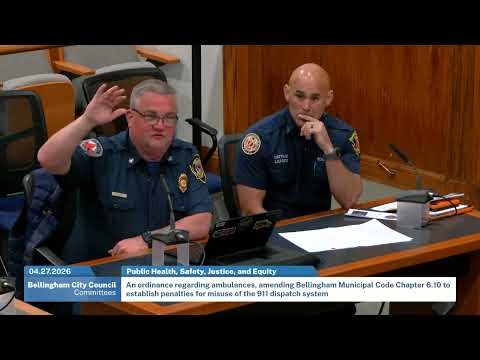
Council Member Hamill, chairing the Committee on Public Health, Safety, Justice and Equity, introduced the ordinance and called Fire Chief Bill Hewitt and Community Paramedic Steve Larson to explain why the change is needed. "This ordinance is very tightly focused only about licensed care facilities," Hewitt said, describing the measure as an incentive rather than a revenue source.
The ordinance targets situations the department described as "nonemergent falls" or lift assists where patients are not injured or in need of transport. "We're talking about individuals that need assistance moving from a recliner to a bed," Larson said. He told the committee the fire department responds about 231 lift-assist calls to licensed care facilities each year and that in 2024 nearly 45% of those facility lift-assist calls did not result in transport.
Larson and Hewitt emphasized two stated goals: reducing inappropriate use of 911 to preserve emergency response capacity and supporting vulnerable residents and facility staff by encouraging adequate training and staffing. "Seconds means lives, and that's a big deal to me," Hewitt said, arguing repeated nonemergency calls can delay response to true emergencies.
Council Member Williams moved to approve the ordinance for first and second readings and later moved an amendment to specify the penalty amount. Legal counsel and staff noted the draft language did not include a dollar figure; the committee amended section d of the proposed ordinance to read that the fire chief or designee "shall be authorized to issue a penalty charge in the amount of $1,000 for each incident determined to be nonemergency lift assistance at licensed care facilities." Staff said the penalty may be waived or reduced for mitigating circumstances.
Committee members asked about the basis for the $1,000 figure. Staff cited comparative amounts in other cities (Tacoma $850, Everett $600, Cincinnati $1,000), the typical time an aid call consumes (reported in the discussion as roughly 30 to 43 minutes), and an average Medicare/Medicaid transport cost the department uses of more than $3,000 as rationale that $1,000 is a reasonable deterrent without seeking to generate revenue.
Several council members expressed concern that a fine might discourage facilities from calling 911 in genuine emergencies. Larson and Hewitt repeatedly said the policy applies only to licensed care facilities and that responders would always treat a suspected emergency as an emergency; enforcement would be after the fact and paired with an educational outreach tour they plan to launch if the ordinance advances.
Council Member Cotton asked why adult family homes were included when some other cities exclude them. Staff said adult family homes were considered for inclusion if licensed medical staff are present, and that larger assisted-living and skilled-nursing facilities are the higher utilizers in these calls.
The committee adopted the amendment on a voice vote, 3-0, and then passed the amended ordinance, 3-0. Chair Hamill said staff would bring the item forward to the full City Council that evening.
What happens next: the committee's approval with the $1,000 amendment sends the ordinance to the full council for consideration; staff said they will begin education and outreach to affected facilities if the ordinance proceeds to final adoption.