Get Full Government Meeting Transcripts, Videos, & Alerts Forever!
Get email alerts on the Public Safety topic
No spam. Unsubscribe anytime.
Bellingham committee recommends temporary alley closures to curb downtown drug activity
Summary
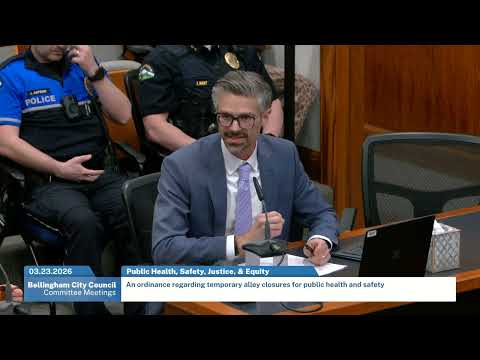
A Bellingham City Council committee voted 3-0 to recommend an ordinance authorizing the public works director, at the police chief's request, to temporarily close targeted downtown alleys to disrupt entrenched drug dealing, preserve access for businesses and enable safety upgrades.
The Bellingham City Council Public Health, Safety, Justice and Equity Committee voted 3-0 to recommend an ordinance that would give the public works director authority, at the request of the police chief, to temporarily close specific downtown alleys to address concentrated illegal drug activity.
Deputy Administrator Forrest Longman told the committee the measure is intended as an "experimental, targeted, temporary" tool to disrupt entrenched drug dealing and provide respite for businesses, employees and residents adjacent to affected alleys. "It also provides a respite to the people who work and live adjacent to these spaces and need to access them on a daily basis," Longman said.
Longman presented city data showing concentrated problems in a three-block section of alleyways in 2025, including 108 reported incidents of violence, 342 drug-related calls and 89 overdoses. He said public works spent about $234,000 on downtown cleaning last year, roughly $185,000 of which went to two alley sections; year-to-date cleaning for those sections exceeded $40,000.
The ordinance would retain access for businesses, property owners, vendors, utilities, sanitation workers and emergency personnel, Longman said, and would make unauthorized entry a misdemeanor. He emphasized the city would use the tool sparingly and hoped the initial phase would emphasize education rather than citation: "We're hopeful that this would result in 0 citations," he said.
Deputy Chief Jay Hart of the Bellingham Police Department supported the measure as a way to increase public safety. "We try to be visible and present in those areas... The problem is we can't be there all the time," Hart said, arguing closures can reduce opportunities for predatory drug dealing.
Committee members framed the ordinance as one of many efforts to stabilize downtown. Council member Holly Huffman and others cited existing services—the mobile opioid treatment unit, a way station with hygiene services, outreach teams and mobile medical units—and the mayor underscored that closures are meant to target illegal dealing, not to criminalize people experiencing substance use disorder or people who are unhoused.
Council member Hamill described outreach data: the mobile treatment site currently serves about 20 active clients with up to 40 periodic clients, and staff plan to seek qualitative feedback from businesses and outreach providers and meet biweekly to monitor impacts.
Several members asked about displacement risks—whether closures would simply move illegal activity to nearby blocks. Longman acknowledged uncertainty and said the city has identified priority alleys (between Railroad and Cornwall and between Holly and Ogg/Magnolia) and will evaluate any displacement and unintended consequences.
Council member Skip Williams moved to recommend the ordinance; a recorded committee vote was 3-0 in favor. The committee did not record a second in the committee exchange. Chair Hamill said he will bring the measure to the full council that evening.
A brief procedural note: during Q&A one speaker mistakenly addressed the deputy administrator as "Debbie Longman;" the deputy administrator gave his name in presentation as Forrest Longman.
What happens next: the committee recommended the ordinance to the full council for consideration that evening; staff said they will monitor outcomes and pursue CPTED (crime prevention through environmental design) improvements if closures create opportunities to do so.