Get Full Government Meeting Transcripts, Videos, & Alerts Forever!
Get email alerts on the Housing Surplus Disposition topic
No spam. Unsubscribe anytime.
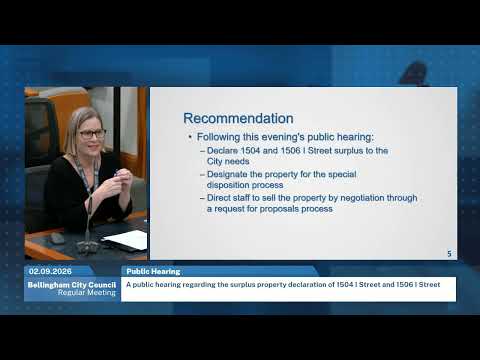
Council declares 1504 and 1506 I Street surplus, directs RFP for special disposition to favor affordable housing
Summary
After a public hearing with three speakers, the Bellingham City Council voted 7–0 to declare two duplex parcels (1504 & 1506 I Street) surplus and to pursue a negotiated RFP under BMC 4.84 to prioritize mission-driven nonprofits and affordable housing or transitional programs.
The Bellingham City Council on Feb. 9 voted unanimously to declare 1504 and 1506 I Street surplus to city needs and to designate the properties for special disposition, directing staff to sell by a negotiated request-for-proposals process that will allow consideration of public benefit and below‑market outcomes.
Tara Lisonbee, the city’s community and economic development manager, told the council the two-unit property in the 1500 block of I Street is about 2,200 square feet and was conveyed in 1990 to the Opportunity Council with a reversionary clause. Lisonbee said the city’s real estate team recommends exercising the revisionary option so the city can “retain this property for use by other community organizations” and issue an RFP that can weigh public benefit, including long‑term affordability.
During the public hearing, Adam Bellinger asked if the property had been inspected for contamination (including meth and underground storage tanks) and recommended selling the parcel on the open market and using proceeds to fund tiny‑home units; Bellinger said assessor values place the property near $700,000–$800,000. Online commenter Michael Shavarrio urged the council to consider community land trust proposals, arguing CLTs can preserve permanent affordability. Carrie Burnside, board president of the Future Home Buyers Organization, urged prioritizing nonprofit stewardship and long‑term affordable ownership rather than allowing the parcel to enter speculative markets. “Housing becomes affordable when we stop treating land as a speculative asset,” Burnside said.
Council members discussed how the RFP should be scored. Council member Michael Lilliquis moved the surplus declaration and designation for special disposition, seconded by Council member Skip Williams. Several council members said they did not want the requirement of operator ‘‘experience’’ to automatically exclude newer mission‑driven groups; staff said they could reword the RFP to prioritize demonstrated ability to deliver and encourage partnerships between emergent organizations and experienced providers. Lisonbee said staff had solicited informal letters of interest from about 25 agencies and received four responses indicating possible interest in a future RFP.
After discussion, the council approved the motion 7–0. Next steps are for staff to finalize and issue the RFP immediately (Lisonbee said the RFP was drafted and expected to be posted the following day or shortly thereafter), evaluate proposals based on the criteria adopted, and negotiate a recipient that meets the RFP’s program and maintenance requirements.
Action and procedural context: the decision is a declaration of surplus under BMC 4.84 and a direction to staff to use the city’s special disposition process; no specific purchaser was selected and no contract was executed at this meeting. The city will return to the council if the RFP process produces a recommendation requiring council action.