Get Full Government Meeting Transcripts, Videos, & Alerts Forever!
Get email alerts on the Culvert Remediation topic
No spam. Unsubscribe anytime.
Committee recommends adopting voluntary interagency culvert‑remediation implementation plan with tribal co‑managers
Summary
Committee members recommended approval of an interagency memorandum of agreement that adopts an inventory, prioritization and a milestone‑based implementation plan for city‑owned culverts, coordinating the City of Bellingham with Lummi Nation, Nooksack Indian Tribe and Washington Department of Fish and Wildlife.
The Public Works & Natural Resources Committee voted to recommend that the city adopt a voluntary interagency culvert remediation implementation plan and a memorandum of agreement that updates a 2022 MOA among the city, the Lummi Nation, the Nooksack Indian Tribe and the Washington Department of Fish and Wildlife.
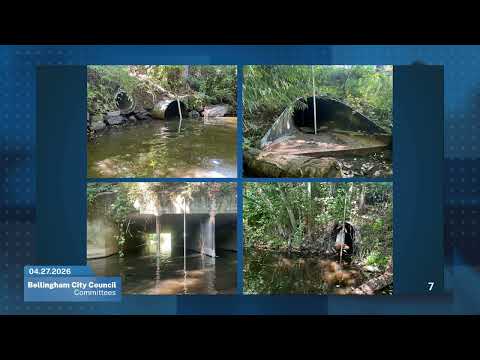
Annalise Burns, the city’s Habitat and Restoration Manager, told the committee the implementation plan adopts an agreed inventory and prioritization of the city’s culvert barriers. Burns said Bellingham is responsible for roughly 90 miles of anadromous habitat and 174 city‑owned culverts that intersect streams; staff identified 126 culverts that are full or partial barriers to fish passage.
Burns reported a cost estimate of about $289,000,000 to address the top 60 highest‑priority barriers. She said predictable grant funding at roughly $1.5 million per year would be insufficient (a simple estimate would stretch completion of the top 60 to nearly two centuries), so the MOA frames progress in milestones: a near‑term six‑year project list, a 30‑year goal to open 25% of blocked habitat and a 60‑year projection to open 50% of blocked habitat. Burns said the plan requires annual coordination among signatories, shared review of designs at scoping and 30/60/90 percent design milestones, and joint efforts to pursue regulatory permissions and funding.
Burns said the partnership has already delivered results: three barriers were completed in 2024–25, eight barriers are in design, and Patton Creek at 30th Street was identified as the next construction project with a 2027–2029 window. She also told the committee staff are finalizing grant applications this month totaling more than $22,000,000.
Committee members asked about use of stormwater utility funding, whether grants can cover staff and design time, and how the implementation plan should be linked to the city’s comprehensive and stormwater plans. Burns and other staff said the stormwater utility provides match and long‑term maintenance funding and that recent grants have included staff time for design and administration. Burns noted the plan is named in the city’s comprehensive planning work and staff recommended linking it to the multimodal and stormwater planning processes where appropriate.
Council member Lisa moved approval of agenda item 24916 to adopt the voluntary culvert remediation implementation plan and associated MOA; the committee responded by voice vote in favor, and Chair Littlequist said she would present a positive recommendation to the full council.
If the council approves the MOA, staff said they will implement the plan through the six‑year project list and annual coordination with tribal co‑managers and the Washington Department of Fish and Wildlife.