Get Full Government Meeting Transcripts, Videos, & Alerts Forever!
Get email alerts on the Municipal Court topic
No spam. Unsubscribe anytime.
Bellingham Municipal Court reports record caseloads, expands diversion and virtual services
Summary
Judges told the City Council the municipal court handled a record number of filings in 2025, is adding warrant-quash calendars and virtual-court capacity, and highlighted therapeutic programs that reduced recidivism among graduates.
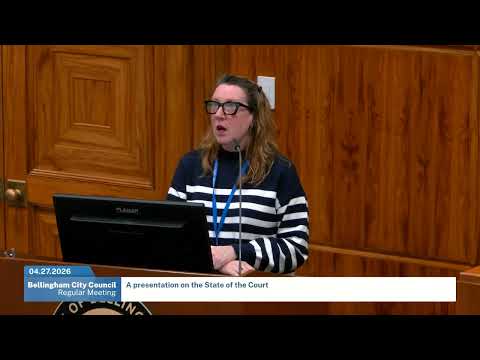
Bellingham Municipal Court judges and staff told the City Council on April 27 that the court handled a record caseload in 2025 and has added calendars and programs to manage the increase. Judges Deborah Lev and Nick Henry and Court Director Tammy Bennett said the court processed 27,079 total filings in 2025, including about 3,065 criminal filings, and that parking citations and infractions together numbered roughly 22,000.
The presenters said criminal filings in the first quarter of 2026 rose about 22% compared with the same quarter in 2025 and that overall filings including infractions and parking were up about 49% for the same period. "2025 had the highest number of cases that we've ever had," the court said in the presentation, and hearings rose as well: staff reported roughly 14,500 criminal hearings in 2025 and an 18% increase in hearings year over year for Q1 2026.
To address the backlog of bench warrants, court staff reported about 4,000 active bench warrants and said the court now runs multiple warrant-quash calendars, including two added warrant-quash calendars that could each hear roughly 25 to 30 people per session. Staff said the court issues about 2,600 warrants a year and that last year about 2,700 warrants were returned (1,400 quashed in the courthouse and roughly 1,300 served by the Bellingham Police Department). Court leaders said expanding calendars could potentially quash up to several hundred warrants per month but noted success depends on defendants appearing.
Judges described pretrial and post-conviction supervision arrangements with Whatcom County District Court Probation, which manages testing, treatment monitoring, GPS and SCRAM alcohol bracelets and other compliance tools. The court said it averaged about 785 active probation cases per month in 2025 and that the increased case volumes are stretching prosecutors, public defenders and probation staff.
Court leaders highlighted therapeutic courts as a key strategy. Judge Henry said wellness court celebrated its 10th anniversary and that recent graduates (2023'024) showed an 84% decrease in subsequent criminal charges and law-enforcement contacts. Community court, launched in January 2025, had about 28 participants in 2025 and provides wraparound supports, a community pantry and a points system tied to individualized case plans; the court reported four graduates in 2025.
The court also described operational changes: a contracted pro tem judge is handling infractions and parking calendars; a mobile "virtual court" cart will allow fully virtual sessions from judicial officers' offices; and the statewide Administrative Office of the Courts will replace the decades-old JIS case-management system with a cloud-based platform this fall, including mandatory e-filing.
Council members pressed presenters on program capacity, how therapeutic courts link to community providers, and whether Bellingham-only long-term detainees are driving jail bed-days. Judges said community and wellness courts extensively coordinate with local behavioral-health and treatment providers, that community court is at capacity and wellness court has a higher entry threshold, and that relatively few people are held solely on Bellingham charges long-term. They also described limits of monitoring tools: SCRAM bracelets detect alcohol only, while probation includes urinalysis for drugs.
The presentation concluded with council members thanking the judges and court staff and noting continued interest in supporting diversion programs, probation resources and systems that reduce unnecessary jail days.