Get Full Government Meeting Transcripts, Videos, & Alerts Forever!
Get email alerts on the State Housing Legislation topic
No spam. Unsubscribe anytime.
Arlington commission hears overview of 2026 Virginia housing bills, from tenant protections to production incentives
Summary
County housing staff briefed the Arlington Tenant-Landlord Commission on dozens of 2026 General Assembly bills affecting tenants and landlords, highlighting new tenant protections, local options for preserving affordability, and measures to boost housing supply.
At a Wednesday meeting, the Arlington County Tenant-Landlord Commission heard a detailed briefing from county housing staff on 2026 Virginia General Assembly measures that affect tenants, landlords and local housing policy. Joel Franklin, a housing planner, and Brian Estes, the county's legislative and policy analyst in the county manager's office, reviewed how bills move through Richmond and summarized measures that passed, were continued for further study, or are options for local implementation.
Franklin said the session produced a large number of housing-related bills and summarized several tenant-protection and affordability measures. "There were a large number of bills that targeted tenant protections," he said, and listed measures that extended the late-rent grace period and expanded other tenant remedies.
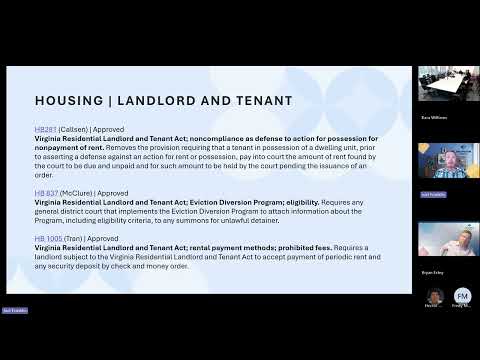
Key bills flagged for commissioners included House Bill 15 and Senate Bill 48, which extend the late-rent grace period from five to 14 days, and House Bill 281, which removes a previous requirement that a tenant pay rent in court before defending a case when withholding rent to compel a landlord to address serious maintenance problems. Franklin also listed HB837, which expands access to eviction diversion programs and requires notice of available resources prior to eviction procedures, and HB1005, which bars landlords from charging extra fees for the method of rent payment.
On production and local tools, staff highlighted bills that would expand local authority to preserve affordability and support worker homeownership. Franklin described House Bill 4, which would permit local ordinances giving a locality a right of first refusal to preserve publicly supported properties as affordable for at least 15 years, and HB352, which would allow industrial or economic development authorities to establish affordable-housing performance grant programs. Staff also noted bills (listed in the presentation as SB328 and HB164) that would lift local caps on grants to help government workers buy homes in the communities they serve.
Franklin called particular attention to two statewide changes with local implications: HB888, which caps minimum off-street parking near transit (for example, 0.5 spaces per multifamily unit in designated areas, with local reduction-request processes required for jurisdictions over 20,000 people), and the 'faith and housing' measures (Senate Bill 388 and House Bill 1279) that allow eligible faith-based or tax-exempt nonprofit property owners who have owned sites at least five years to develop affordable housing by right; those developments must be at least 60% affordable to households at or below 80% of AMI and would be subject to local environmental, historic and architectural standards.
Commissioners raised implementation questions and voiced the need for robust stakeholder engagement. Scott Pedowitz, representing Aoba, said one reason some local proposals failed was a perception that housing providers and developers had not been adequately engaged. "Big part of why that got defeated was concern from the housing provider and housing developer community that those groups had not been robustly engaged," Pedowitz said. Estes responded that staff is developing a plan for community input and hopes to have more information in the coming weeks.
Staff also flagged HB1212 (presented in the briefing as authority to permit small-lot single-family homes in jurisdictions over 50,000 people) and other bills related to streamlining approvals for affordable housing (HB594) and preserving long-term affordability through local ordinance. Franklin advised commissioners to consult the Virginia legislative information system for full texts and said county staff (including the county attorney's office and CPHD) are reviewing which ordinances must be updated to comply with state changes and which local options warrant fuller public processes.
The briefing concluded with staff's proposed calendar for local legislative priorities: a Legislative Affairs '101' session for commission chairs or designees, a June 1 request-for-input to advisory groups, summer work sessions, and a package to be developed in the fall for presentation around October and Board approval in November. Estes said that staff and lobbyists will provide feedback on early ideas to prevent wasted effort on concepts unlikely to succeed at the General Assembly level.
The commission did not take formal votes on any bills at the meeting; the only formal action recorded was approval of the April minutes and adjournment.