Get Full Government Meeting Transcripts, Videos, & Alerts Forever!
Get email alerts on the Transportation Impact Fees topic
No spam. Unsubscribe anytime.
Bellingham staff outline transportation impact fee update, cite new Supreme Court standard
Summary
City staff presented a comprehensive update to Bellingham's transportation impact fee methodology, citing a recent Supreme Court decision that shifts documentation burdens to municipalities; staff showed the new per-person-trip calculation and described credits for ADUs and affordable housing.
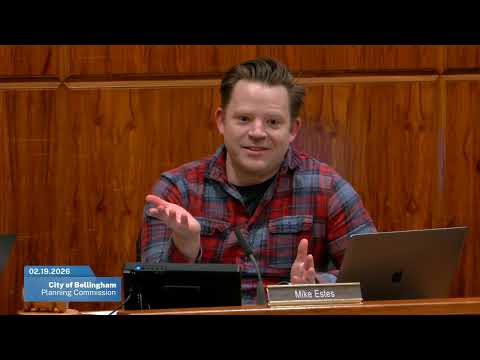
City staff and consultants on Feb. 19 walked the Bellingham Planning Commission through proposed updates to the city's transportation impact fees (TIF), saying methodological changes and recent court guidance mean the city must clearly document and justify how it sets rates.
Chris Como, introduced in the meeting as a senior planner with Transpo, said the update uses the Institute of Transportation Engineers' (ITE) 12th edition and regional travel demand models (Whatcom Council of Governments, PSRC) to convert the comp-plan project list and growth forecasts into a per-person-trip cost. "Now the city has to justify how it's been done and, has to show their work, essentially," Como said, describing the effect he attributed to the Sheetz Supreme Court decision.
The consultant and staff described how they overlaid the 20-year project list on transportation analysis zones to compute TIF-eligible costs. Staff identified 24 multimodal corridor projects and grouped pedestrian and bicycle "catalyst" projects (10 pedestrian groups, 12 bicycle groups) as TIF-eligible, and said ineligible items include maintenance, studies, bridge reconstruction and mitigation projects required by other permits.
Using the project list and person-trip conversion factors, staff reported a calculated cost-per-person-trip of $1,770.13. In an example shown to commissioners, that yielded a single-family-home example fee of about $3,239.34 under the new calculation compared with $3,857.29 under the city's prior 2025 figure; staff emphasized the numbers are not strictly comparable because the methodology has changed.
Commissioners pressed staff on implementation details. Dylan (staff) read the ITE land-use descriptions for categories like convenience stores and explained how different land-use categories or defensible, industry-accepted adjustments (such as diverted links) can lower a project's calculated TIF if supported by analysis. Staff said a transportation impact analysis (TIA) is typically required when a development generates more than about 50 PM peak vehicle trips, while the TIF applies more broadly: "Any development that creates more than 1 PM peak person trip is required to pay a transportation impact fee," Dylan said.
Staff also summarized credit and exemption options codified in Bellingham Municipal Code (the 19.06 series): a state-mandated 50% ADU credit, an 80% reduction for income-restricted affordable housing, automatic urban-village reductions (roughly 25% in some circumstances) and negotiated credits (for example, historic traffic-credit arrangements linked to waterfront development and the Port of Bellingham). Staff stressed that impact fees themselves are not negotiable, but developers may submit alternate, defensible trip studies that the city can accept if the methodology is robust.
Commissioners asked how annual receipts compare to the 20-year program total. Staff said a recent high year collected roughly $2 million and that the 20-year program total (about $104 million in the project list) represents the theoretical allocation before credits, ineligible items and later policy choices reduce the collectible amount.
The presentation was informational; staff said the TIF rate schedule and the calculation spreadsheet will be available to commissioners and that future work will refine the numbers before any council action.
What happens next: staff will circulate the rate sheet and supporting analyses for review; the TIF update was presented as an information item and not a formal action at this meeting.