Get Full Government Meeting Transcripts, Videos, & Alerts Forever!
Get email alerts on the Public Testimony topic
No spam. Unsubscribe anytime.
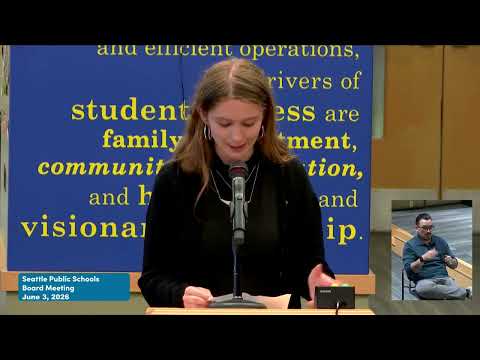
Parents and advocates press Seattle board over middle-school ELA, ethnic studies and behavior supports
Summary
Dozens of public commenters urged the board to let teachers choose texts, defend authentic ethnic-studies programming, and invest in upstream behavior interventions like Collaborative & Proactive Solutions rather than relying on expensive out-of-district placements.
At the start of public testimony the board heard sustained criticism of the district’s middle-school ELA curriculum, calls to restore teacher flexibility to teach full novels, and warnings that the current curriculum alienates students and reduces deep reading opportunities.
Parent Julie Lechner told the board she had discovered that “books are actually not part of the SPS middle school curriculum,” and asked for two immediate actions: give teachers flexibility to pick texts, including full novels when appropriate, and start the process to replace the current curriculum contract. Several other parents and a middle-school language-arts teacher echoed that request, saying students’ engagement and deep-reading skills suffered when teachers were forced to follow the existing program rigidly.
Speakers also raised concerns about ethnic-studies programming. Dr. Tracy Castro Gill, co-founder of Washington Ethnic Studies Now, said the district’s ethnic-studies program “has been completely dismantled and is at risk of being co-opted by a racist organization, ironically named the Foundation Against Intolerance and Racism, or FAIR,” and asked the board to partner with community groups and the NAACP Youth Council to protect program integrity.
Special-education advocates urged the board to invest in prevention and in-district capacity-building. Pamela Phillips of the Seattle Special Education PTSA noted the district’s recent spending on contracted behavioral and special-education services and placements and said the system spends “over $100 million in reactive downstream spending” because upstream supports are missing. Several speakers asked the board to approve and scale Collaborative & Proactive Solutions (CPS) training and to prioritize building district capacity rather than outsourcing.
Board members listened; several thanked speakers and noted follow-up actions (for example, a grant before the board to accept BF Day PTSA funding to support CPS-aligned training). There were no immediate policy votes tied directly to public testimony.