Get Full Government Meeting Transcripts, Videos, & Alerts Forever!
Get email alerts on the Fund Accounting topic
No spam. Unsubscribe anytime.
Staff proposes charter cleanup to simplify Glendale fund accounting and improve transparency
Summary
City staff recommended revising charter fund language to align with generally accepted accounting principles, consolidate legacy funds into a general fund plus discrete enterprise funds, and make capital set-asides and depreciation accounting clearer for elected officials and the public.
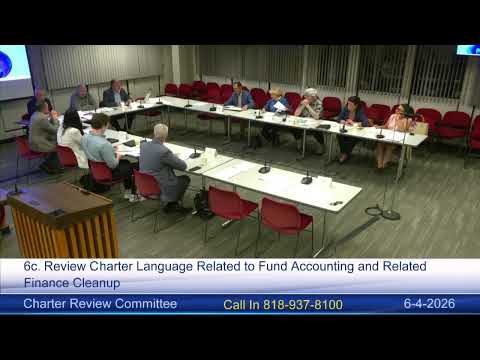
City finance staff told the Charter Review Committee on June 4 that much of the charter's fund-accounting language is outdated and inconsistent with modern, GAAP-based municipal accounting, and proposed streamlined charter language to improve transparency and efficiency.
Finance Director Jack Leon summarized the issue: the city currently maintains roughly 78 funds across operations and utilities, many of which are legacy charter provisions dating back decades. Staff proposed consolidating most routine operations into a city general fund plus separate enterprise funds for the water and electric utilities; other legally restricted funds would remain separate as required by law or GAAP. "We view this as largely a cleanup to make our charter funds consistent with generally accepted accounting principles," Leon said.
Staff noted the proposal would not change the legal authority for transfers between funds. For example, the charter currently includes provisions that require end-of-year transfers between utility reserves and the general fund; staff said the cleanup would not alter the legal calculus but would remove procedural duplication and make capital set-asides (the items the charter currently calls "depreciation" funds) visible and auditable.
Committee members asked for specific examples and an explanation of how the change would affect capital planning. Staff explained the current language has caused confusion (for example, a "depreciation" fund that actually functions as a capital-project account and a surplus reserve that currently absorbs year-end balances), and said the proposed redraft would make clear which balances are held for capital replacement and which are available for transfers. Members asked staff to return with cleaned final language for the committee to consider at the next meeting.
The committee did not adopt charter changes at the meeting; staff agreed to prepare a refined draft that shows exactly how reserve and depreciation/capital-setaside balances will be tracked and reported for public transparency.