Get Full Government Meeting Transcripts, Videos, & Alerts Forever!
Get email alerts on the Sewer Rates topic
No spam. Unsubscribe anytime.
Crescent City council adopts sewer rate increase after public protests fall short
Summary
After lengthy public comment and a consultant presentation showing a structural deficit, the council adopted an ordinance raising sewer rates and approving a multi-year schedule intended to stabilize the sewer enterprise fund and fund near-term capital needs. Protest tabulation fell short of a Prop 218 majority.
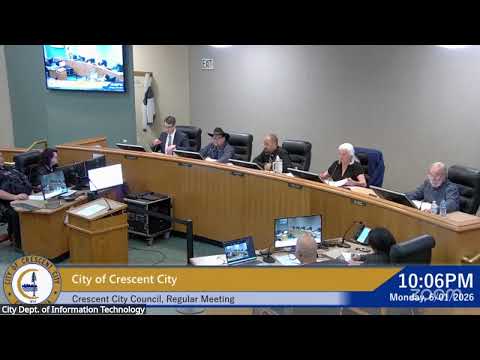
Crescent City Council adopted Ordinance No. 863 on June 1, 2026, approving a multi‑year increase to sewer rates after a public hearing in which residents pressed the council on affordability, transparency and past procurement practices.
The council’s vote followed a comprehensive presentation from city staff and Chris Fischer of Willan Financial, who said the sewer enterprise fund is in a structural deficit after more than a decade without rate adjustments and that doing nothing would exhaust reserves and jeopardize regulatory compliance. Fischer described roughly $9–10 million in near‑term capital needs to maintain and rehabilitate aging sewer infrastructure, and he recommended a sequenced rate schedule to restore operating and capital reserves while meeting debt service requirements.
Opponents during public comment warned of the effects of sharp increases on low‑income households and questioned whether grant funding or cost reductions could avoid passing costs to ratepayers; some commenters alleged prior local procurement wrongdoing and urged criminal or restitution investigations. Supporters including community organizers said deferred maintenance and the risk of catastrophic system failure require an infusion of revenue now to protect public health.
The city clerk reported that the Proposition 218 protest tally did not reach the 50% plus one threshold required to block the proposed rates (1,444 protests reported vs. the required 1,799 parcels), so the council proceeded to consider the ordinance. The motion to adopt Ordinance No. 863 passed 4–1 (Council member Alman voted no; Council members Go, Shamblin, Mayor Prom Tinkler and Mayor Wright voted yes). The ordinance amends Chapter 13.30 of the municipal code to implement the adopted rate schedule.
The staff presentation and consultant report remain posted on the city website, and staff offered to schedule plant tours and one‑on‑one review meetings for residents who want a deeper review of the financials and the capital plan. The ordinance takes effect under the city’s Prop 218 schedule and will be implemented as described in the adopted rate table.
The council described the adopted path as a risk‑management decision: higher near‑term rates intended to reduce the chance of emergency system failures, which staff said would be costlier and could prompt state intervention if the city failed to meet discharge and operational requirements.