Get Full Government Meeting Transcripts, Videos, & Alerts Forever!
Get email alerts on the Law Enforcement Oversight topic
No spam. Unsubscribe anytime.
Community group urges Humboldt County to create civilian oversight board with subpoena power
Summary
A civilian working group told the Humboldt County Human Rights Commission it has drafted an ordinance to create a community oversight board and an independent inspector general with subpoena authority for the sheriff’s office and county jail, pointing to AB 1185 and other California counties as precedents.
Community presenters proposed that Humboldt County adopt an ordinance creating a civilian oversight board and an independent inspector general with lawful subpoena power to increase transparency into the sheriff’s office and county jail.
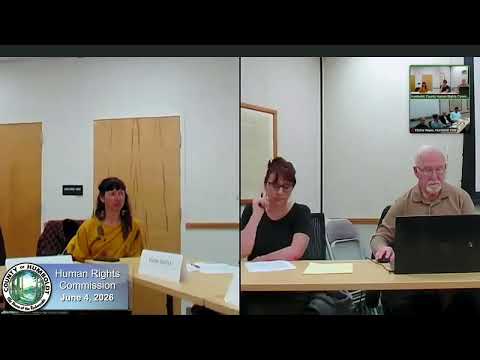
At a meeting of the Humboldt County Human Rights Commission, presenters led by Nadia Van Liz described a roughly 10-person civilian working group that drafted a model ordinance after outreach and review of other jurisdictions. The group said the proposal would not remove the sheriff’s authority or manage day-to-day policing but would provide public reporting, policy recommendations and a formal avenue for incident review.
The presenters cited California Assembly Bill 1185 as the legal authorization for county-level sheriff oversight bodies and listed several counties that have similar models. They said AB 1185 can provide subpoena authority for oversight bodies and point to those powers as essential to meaningful review.
"What we're proposing with oversight and increased transparency doesn't automatically change conditions — there's no power within this board to, like, [directly] change things — but by making things more transparent it opens up more opportunities to improve conditions," said Nadia Van Liz, one of the presenters.
The group said the proposal would explicitly include the county jail and the coroner’s office within the oversight scope. Presenters emphasized three core elements they consider essential: subpoena power, genuine independence (including a funded office of an inspector general) and a diverse, trained membership. They noted that an inspector general position in the nearby City of Eureka runs about $90,000 a year and said county costs would likely be higher, although presenters suggested options such as contracting with a firm already used by Eureka.
Presenters acknowledged resistance from Sheriff Hanzel: "Sheriff Hanzel is not a huge fan of this proposal," the group said, while stressing the intention to continue dialogue. They also described a history of prior local efforts that stalled after law-enforcement pushback and argued national events and new state law make this moment different.
Commissioners asked whether the ordinance would force adoption of recommendations; presenters said recommendations would be public but not binding on the sheriff, and that the value lies partly in public engagement and the potential to reduce liability through improved transparency.
The presenters asked the commission for support and suggested sending a formal recommendation to the board of supervisors. They said they expect the board of supervisors to consider adoption in September and offered to return to the commission in August for a follow-up presentation and to supply a recirculated draft ordinance.
The commission did not vote on the ordinance at this meeting but encouraged the presenters to continue outreach, to provide the draft ordinance to commissioners who did not receive it, and to return with follow-up materials. The presenters said they would meet with staff and supervisors and return in August if feasible.
Next steps: the presenters will resend the draft ordinance to commissioners, continue meetings with supervisors and return for a follow-up session; the board of supervisors is the body that would formally adopt any ordinance or refer the matter to voters.