Get Full Government Meeting Transcripts, Videos, & Alerts Forever!
Get email alerts on the Police Compensation topic
No spam. Unsubscribe anytime.
Council debates lieutenant pay and whether Act 12 supplemental aid should shore up public-safety pay
Summary
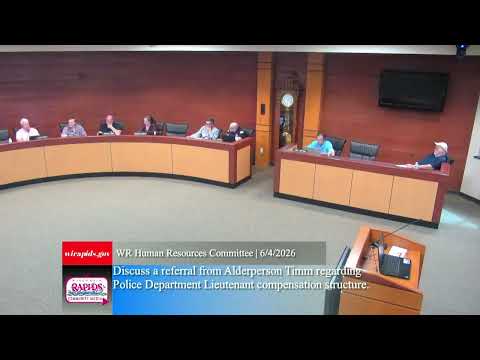
Councilors discussed a referral on police lieutenant compensation and wage compression, weighing a near-term cost of under $8,000 for 2026 against a roughly $37,000 annual cost in 2027 and debating whether 2023 Act 12 supplemental county/municipal aid should be used to preserve public-safety service levels.
The council spent the bulk of the meeting examining a referral from Alderperson Tim about police lieutenant compensation and a wider problem of salary compression between patrol sergeants and lieutenants.
Ryan, the human-resources director, said the city’s wage-scale policy calls for market-rate reviews every two to three years and that the city is entering the third year of its current schedule, meaning a full evaluation would feed into the 2027 budget process. “HR director Ryan said the policy allows a market-rate review now that the three-year interval has elapsed and the evaluation would be used for the 2027 budget,” Ryan told councilors.
Council members and staff described a timing and policy problem: union step increases and the mechanics of how non‑represented promotions are applied can produce situations where a newly promoted lieutenant or battalion chief could start at a pay level equal to, or ahead of, an incumbent supervisor. Ryan warned that the “waterfall” effect from steps and promotion timing could create situations where newly promoted staff would begin ahead of longer-serving supervisors if not addressed.
Several council members argued there is an available funding source that might be used to address the shortfall. They discussed 2023 Act 12 supplemental county/municipal aid — state funding intended to help municipalities with public-safety, EMS, radio communications and related costs — and noted Wisconsin Rapids expects nearly $1 million in such aid for 2026. A council member questioned whether the city is using the money in line with the act’s intent if public-safety services are not being maintained despite the new revenue.
Cost estimates discussed in the meeting: councilors cited a net cost for the remainder of 2026 of under $8,000 (assuming implementation on June 30) and an annualized figure of about $37,000 beginning in the 2027 budget, figures the city’s memo provided to the council.
No formal motion was made. Council members proposed options for resolving compression: align cost-of-living adjustments for represented and non‑represented employees, give department heads more discretion to place promoted employees on appropriate steps within a grade, or perform a full wage-scale review for the 2027 budget. The council agreed to keep the compensation issue and a related referral on the July agenda for further work and possible policy changes.
Why it matters: Councilors said compression could discourage internal promotions and erode supervision, potentially affecting police and fire service levels if not addressed. Some members pressed for transparency about how supplemental state aid is allocated and whether it preserves public-safety service levels required by Act 12.
What’s next: The council will revisit the referral and related pay-structure proposals during future meetings and consider salary-scale adjustments as part of the 2027 budgeting process.