Get Full Government Meeting Transcripts, Videos, & Alerts Forever!
Get email alerts on the County Budget topic
No spam. Unsubscribe anytime.
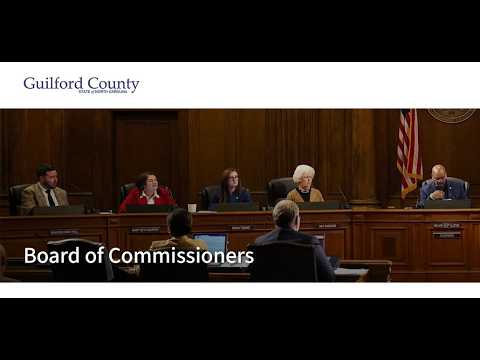
Guilford County public hearing draws split over proposed FY2026-27 budget and tax rate
Summary
Dozens of residents told the Guilford County Board of Commissioners on June 4 that the manager's recommended budget balances urgent needs—schools, eviction prevention and behavioral health—while others warned rising property valuations require a revenue-neutral tax rate to avoid hardship for longtime homeowners and fixed-income residents.
A packed public hearing on June 4 drew more than 40 speakers to the Guilford County commission chamber to weigh in on County Manager Victor Eisler's recommended FY2026-27 budget, with testimony sharply split over whether the board should adopt the manager's reduced-rate option or move to a revenue-neutral tax rate.
Supporters of the manager's proposal urged the board to preserve and expand services that residents and advocates said are at risk if the county reduces revenue to a revenue-neutral level. A Guilford County resident testifying in favor highlighted the budget's additions for homelessness prevention and public health, saying, "The budget establishes a homeless services department. It also allocates $1 million to expand street outreach and emergency sheltering," and noted an $860,000 eviction-mitigation allocation for an expanded landlord engagement and mediation program.
Union and education leaders, parents and teachers argued those investments were vital to keep Guilford County Schools staffed and supported. Joanna Pendleton, president of the Guilford County Association of Educators, said the board had taken a "bold and courageous step" in partnering with the school board on a long-term plan and urged commissioners to fund classified staff raises and programs such as high-dosage tutoring.
Speakers representing tenant-advocacy groups and Legal Aid of North Carolina described the county-funded TEAM/Legal Aid clinic as a proven eviction-prevention force. "Eviction is a crisis," Janet McCaulay Blue, the managing attorney for Legal Aid's Greensboro office, told commissioners, describing the program's courthouse presence and the long-term harms eviction causes.
Other residents urged restraint. Gary Kenton, a Sunset Hills homeowner, criticized the revaluation process and suggested using a longer sales window to smooth spikes in assessments. "If you're basing your new assessments on recent sales, everybody's assessments go way up very quickly," he said. Mike Purdue, another speaker, warned that higher assessments combined with higher rates could force foreclosures, saying bluntly, "You made more people homeless." Several speakers specifically urged the board to adopt a revenue-neutral rate or to phase increases.
Speakers also clashed over the distributional effects of the revaluation: retirees and residents on fixed incomes described hardship and asked for targeted relief; parents and educators warned that cutting county revenues would force reductions in school supports and staff compensation. Multiple commenters said the county was being asked to make up for cuts or shortfalls at state and federal levels.
Legal-aid advocates asked commissioners to continue the county's $860,000 investment in the TEAM clinic, citing work that assisted more than 850 households last year. Tenant-organizer testimony included a claim that "17,000 families are facing eviction across Guilford County," which commissioners did not verify during the hearing but which advocates used to underscore the scale of housing stress.
The public hearing was one stage in a deliberative process: commissioners said they would continue reviewing budget options and public input before a target date for final budget action on June 18.
What happens next: The commission will continue public deliberations, consider the manager's recommended budget and alternatives (including a revenue-neutral option), and is scheduled to consider a final vote on or around June 18.