Get Full Government Meeting Transcripts, Videos, & Alerts Forever!
Get email alerts on the Water Reclamation Facility topic
No spam. Unsubscribe anytime.
Cambria board approves SEIR addendum for water reclamation facility, 4–1, amid questions about zero-liquid-discharge testing
Summary
The Cambria Community Services District board voted 4–1 July 10 to approve an addendum to the Water Reclamation Facility SEIR that adds zero-liquid-discharge (ZLD) as a disposal option for concentrate. Supporters said the inclusion helps permitting; critics and several public commenters said adding ZLD before pilot results risks cost and environmental unknowns.
The Cambria Community Services District board on July 10 approved an addendum to the water reclamation facility’s Subsequent Environmental Impact Report, adding the option of a zero-liquid-discharge system for brine disposal as part of the project’s permit package.
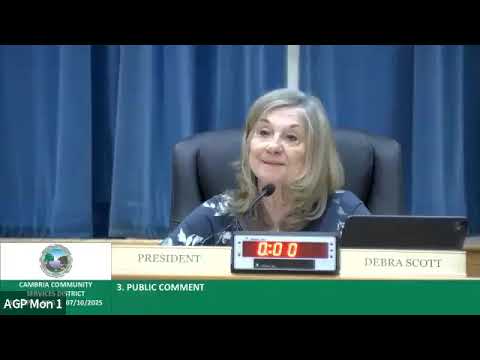
Board President Scott moved the measure and Vice President Thomas seconded. The motion passed 4–1, with Director Farmer voting no and citing unresolved technical and cost questions.
The addendum updates the project description used for permitting under the California Environmental Quality Act to include recent changes in proposed infrastructure and to analyze the potential environmental effects of a ZLD system, altered pond-liner removal options and related tribal-cultural and wildfire impacts. General Manager Melhaney told the board the environmental document "does not lock the district into using ZLD" and that including ZLD in the SEIR is intended to allow a complete permitting review as project details and pilot results become available.
Public commenters said the addendum is premature. Several residents and public-interest speakers pressed the board to delay approval until after a ZLD pilot test is complete and independently evaluated. Commenters cited rough cost estimates – public speakers referenced figures of roughly $2 million for a ZLD installation and about $1 million for pond-liner removal – and warned against committing to construction without demonstrated performance. Crosby and Laura Schwarz and others asked that the SEIR clarify where ZLD-treated water and semi-solid residues would be directed or disposed.
Board members and staff sought to strike a balance: boardmembers said they want the county and the Coastal Commission fully informed while preserving the board’s later authority to decide whether to install ZLD based on pilot performance, operating costs and permit conditions. Director Dean and Vice President Thomas emphasized the district will return to the board before taking any construction or operating decisions that would change costs or water operations.
General Manager Melhaney and staff said the SEIR addendum is a regulatory step not a construction authorization. "Including it in the SEIR aids in moving the permitting process forward," Melhaney told the meeting, adding that operational details, energy needs and long‑term operating costs will be presented to the board before any final selection. District counsel and staff also said brine-disposal alternatives such as hauling to regional facilities remain part of the evaluated options.
The vote leaves the ZLD option in the environmental record for the WRF permitting pathway, while the district proceeds with a pilot program and ongoing discussions with the county and the Coastal Commission. The board directed staff to incorporate minor clarifications to wording in the addendum before finalizing the document.
The board’s approval advances the WRF through permitting stages but does not itself authorize construction of any ZLD equipment; any future installation would return to the board for a separate, substantive decision.