Get Full Government Meeting Transcripts, Videos, & Alerts Forever!
Get email alerts on the Bridge Replacement topic
No spam. Unsubscribe anytime.
County engineer outlines plan to replace 1914 Stark Street Bridge; $35 million estimate, community survey open
Summary
Multnomah County engineers told the Troutdale Citizens Advisory Committee the 1914 Stark Street Bridge is structurally deficient, described preservation and replacement options, and said a public survey (starkstreetbridge.org) and grant applications are underway to fund design and construction.
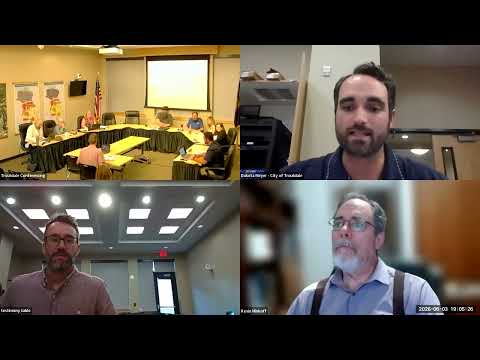
Multnomah County bridge engineer Ryan Rucker told the Troutdale Citizens Advisory Committee on June 3 that the 1914 Stark Street Bridge is well past its service life, structurally deficient and unable to meet modern traffic and seismic standards. "It currently doesn't meet any of the design standards to accommodate today's traffic," Rucker said, adding the bridge has been struck repeatedly and is vulnerable to scour and earthquake forces.
Rucker said the county began environmental review last fall and is conducting geotechnical work, surveys and outreach as it develops a range of alternatives from a no‑build option to one or more replacement designs. He said the county will publish a shortlist and draft evaluation criteria this summer, expects to identify a preferred alternative in 2027 and move to design and construction when funding is secured.
The county is exploring ways to preserve portions of the historic structure — for example, as a pedestrian or bicycle crossing or through relocation — and noted past projects where bridge elements were reused elsewhere in the county. Rucker said the historic value is being weighed alongside safety and resilience goals.
Rucker described recent emergency repairs: a north wing wall that failed in 2024 was replaced with a concrete slab, and repairs completed recently followed several collisions. He said there have been 36 recorded accidents related to the crossing since 2017 and described constraints that currently restrict large vehicles.
As a short‑term mitigation, Rucker said the county is pursuing camera installation at the bridge's north approach to document who is using the roadway and when collisions occur; footage would support possible restrictions on large vehicles at that turn. He also said the county had asked ODOT about traffic control measures; ODOT has been reluctant to add stop signs or signals near the scenic historic corridor, staff said.
On funding, Rucker said the county has applied for US DOT BUILD funds, Bridge Investment Program grants and sought congressional appropriations. "We're thinking late June" for a BUILD decision, he said, and estimated the project cost at roughly $35 million, with a two‑ to three‑year construction period once funds are secured.
The county has a community survey live through the end of June at starkstreetbridge.org to collect local preferences on how people use the crossing and what they want for the future. Committee members and residents asked about right‑of‑way constraints that would affect keeping the existing bridge alongside a new structure, the feasibility of spanning without in‑water piers, and interim safety measures for the high‑speed approach.
Next steps Rucker laid out include finalizing alternatives, completing environmental review and continuing outreach with schools, first responders and adjacent property owners before design and construction phases begin.