Get Full Government Meeting Transcripts, Videos, & Alerts Forever!
Get email alerts on the Comprehensive Plan topic
No spam. Unsubscribe anytime.
Manatee County delays transmission of comprehensive-plan rewrite after marathon public hearing
Summary
After more than five hours of public comment and multi-hour staff and consultant presentations, the Manatee County Board of County Commissioners voted to continue consideration of a proposed comprehensive-plan text update to Aug. 6, 2026, citing residents' requests for more time and concerns about consultant conflicts, wetlands and traffic impacts.
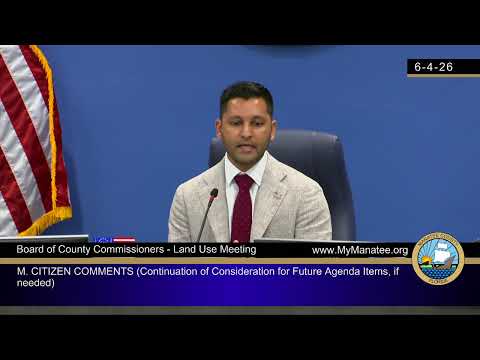
Manatee County commissioners voted June 4 to delay transmitting a county-initiated comprehensive-plan text update to the state, agreeing to bring the matter back at their Aug. 6 land-use meeting after an extended public hearing that filled much of the day.
The hearing centered on a draft package that staff and county-hired consultants described as a multi-year effort to reorganize and update Manatee County’s goals, objectives and policies. Rachel, the division manager for comprehensive planning, told the board the process began in January 2023 and has included "about 15 public workshops" and multiple drafts. "Staff does not believe Senate Bill 180 will be in place permanently. We view this time as an opportunity for staff to prepare policy proposals to propose at the appropriate time," she said during her presentation.
But dozens of residents and community groups urged commissioners not to transmit the 700+-page packet now. Speakers repeatedly asked for more time to review the material and for clearer public outreach. "Residents are asking for transparency, accountability and more importantly, more time to get these things right," said Ashley Bowling, a Manatee County resident who addressed the board during the public comment period.
Concerns voiced by speakers included: allegations that parts of the draft were written by consultants who also work for private developers (a point several commenters raised about the consultant team), the potential loss of wetland protections if language is altered, the effect of new policies on rural places such as Myakka City, and a perceived lack of sufficient public notice and time to read a complex document. Multiple speakers asked the board to follow the Planning Commission’s recommendation that a 90-day public review be allowed before transmission.
Commissioners debated competing priorities. Some members said delaying would be prudent to rebuild trust after earlier controversies and to give people time to digest the draft. Others argued the county had already conducted extensive outreach over several years and that waiting indefinitely would forfeit near-term opportunities — including incentives for the county’s stated affordable-housing goals. Commissioner George Cruz said he favored moving forward with practical, incremental steps: when sweeping solutions aren’t possible, "it's shortsighted to do nothing; we should do what we can now."
After debate, the board voted to continue the transmittal to Aug. 6, 2026. The motion passed 5–1, with Commissioner McCAnn recorded in opposition.
What the transmittal means and what happens next: If and when the board transmits the draft comprehensive-plan text amendments, state agencies will have a formal review period (the process typically includes a 60-day agency review). Depending on the outcome, the county may receive objections or required revisions from state reviewers. Staff told the board they will continue to work on items placed in a "parking lot" — draft policies that may be constrained by current state statutes — and to prepare clarifying materials for the public ahead of the Aug. 6 meeting.
Why residents pushed back: Speakers described a short public-review window for a voluminous document and raised specific local concerns: proposed new language referring to named communities (such as Myakka City and Parrish), potential roadway designations that residents fear will open rural corridors to commercial development, and questions about how wetlands and water-supply issues have been addressed. Several commenters asked the board to hold community town halls and to publish clearer, more accessible summaries of the changes before transmitting the draft to the state.
Staff response and next steps: County staff reiterated that some policy items have been intentionally held back pending SB 180’s status and that the draft reflects three-plus years of work. The board’s Aug. 6 agenda will again include the transmittal hearing and is expected to reopen public comment; staff said they will provide additional materials to explain changes and to itemize the policies currently held in abeyance.
The Aug. 6 hearing will be the board’s next formal opportunity to act on the transmission; if the board transmits at that meeting, the draft will enter the state agency review process and may be subject to objections or requests for modification.