Get Full Government Meeting Transcripts, Videos, & Alerts Forever!
Get email alerts on the Data Centers topic
No spam. Unsubscribe anytime.
Lopatcong Council moves to prohibit data centers in ROM zone after residents’ pushback
Summary
After extended public comment and petitions, the Lopatcong Township Council approved a first reading of ordinance 26‑06 to ban data centers in the Research Office Manufacturing (ROM) zone and voted to send the master plan to the planning board for re‑examination.
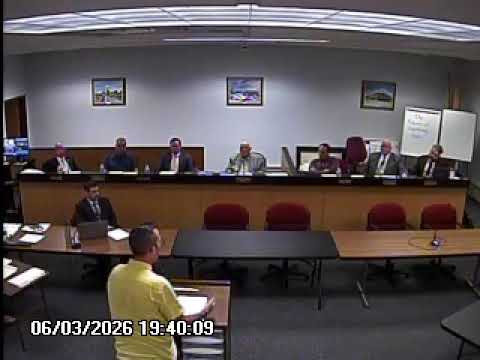
Lopatcong Township Council members voted on June 3 to introduce and approve the first reading of ordinance 26‑06, which would prohibit data centers as principal, conditional or accessory uses in the township’s Research Office Manufacturing (ROM) zone.
Mayor opened the meeting by denying that the township was considering a specific data‑center project, saying “a Lopatcong is not considering a construction of a data center. No one on this council has met with the data center developer.” He added that much of the online discussion was misleading; that comment drew multiple residents to the podium to press the council for clarity and for stronger protections. Resident Brian Sweeney, who said he organized a petition with more than 950 signatures, told the mayor that characterizing “every internet post … as a complete lie is actually a lie in itself.”
Why it matters: residents and neighboring officials warned that large data centers can bring heavy electrical and water demands, continuous noise from backup generators and battery systems, and potential impacts on property values and farmland. Many speakers urged the council to close legal loopholes that could allow warehouses built on spec to be retrofitted later into data centers.
During the public‑comment period, residents raised technical and regulatory questions the council said informed its decision. Patrick Brown urged the council to consider infrastructure realities, telling officials that the “average power pole for a medium‑sized data center … is 160 to 200 feet high,” and asking the council to consider restrictions on transmission poles and on the routing of lines. Tim Moros, a resident with technical concerns, urged explicit battery‑storage fire protections such as reference to NFPA 855, stronger noise standards than those in township chapter 147, and engineering thermal‑impact studies.
Council action and next steps: the council moved, seconded and approved the first reading of ordinance 26‑06 by roll call; members present recorded unanimous affirmative votes. The council also passed a resolution directing the Lopatcong Township Planning Board to undertake a periodic re‑examination of the master plan to reconcile the ordinance with prior master‑plan language that had allowed data centers in the ROM zone. The mayor and council said a second reading and vote on the ordinance will be scheduled in July, while the planning board begins its parallel re‑examination.
Public response and remaining questions: speakers repeatedly emphasized the need to guard against “sneak‑attack” conversions — warehouses built as general industrial uses later retrofitted for intensive data‑center use — and asked the council to ensure the new prohibition and any master‑plan changes are legally robust. Residents also pressed for more public participation in land‑use and planning processes; council members said the master‑plan re‑examination will include a required public hearing and additional outreach may be possible.
What the ordinance says on the record: the ordinance introduced (26‑06) amends chapter 243 of the municipal code to prohibit data centers in the ROM zone, which town officials said is the only zone where data centers are currently permitted. Council members and the township attorney described the two‑track strategy that led to tonight’s action: the planning board earlier proposed conditions to limit data centers; public opposition then prompted the council to pursue an outright prohibition while simultaneously directing a formal master‑plan review.
Other related actions at the meeting: the council allowed ordinance 26‑04 (the version that proposed allowing data centers with conditions) to 'die on the floor' when no motion to proceed was made; the planning‑board re‑examination resolution passed by roll call. The council’s actions do not, the mayor said, rely on any single external developer representation.
The meeting record shows residents, council members and staff continuing to debate implementation details — including noise standards, battery‑storage safety rules, and zoning language to prevent post‑construction conversion of warehouses. The council indicated it will return the ordinance for a second reading in July and expects the planning‑board re‑examination process to proceed in parallel.