Get Full Government Meeting Transcripts, Videos, & Alerts Forever!
Get email alerts on the Db Reporting topic
No spam. Unsubscribe anytime.
TRS guidance: report summer work to the fiscal year it was performed; DB uploads due July 10
Summary
TRS staff instructed employers to use accrual reporting for defined-benefit (DB) payrolls: report earnings in the fiscal year the work was performed (TRS fiscal year July 1–June 30). DB contribution reports and future July/August pay-period uploads must be submitted by July 10 or districts risk penalties.
TRS trainers told school payroll administrators that summer payrolls must be reported on an accrual basis: earnings are reported in the fiscal year the work was performed, not the date a paycheck is issued. “This means that you have to report earnings in the fiscal year that the work was performed,” the presenter said, noting TRS’s fiscal year runs July 1 through June 30.
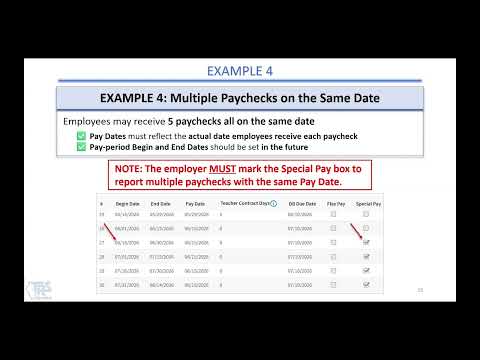
The presentation advised districts to create a complete payroll schedule at the start of the year — listing each pay period’s begin date, end date and the actual pay date — before uploading the first report for the next fiscal year. The presenter said common teacher pay arrangements (nine months of work paid across 12 months) still must be reported in the prior fiscal year for work performed before July 1 even if paychecks are issued in July or August.
For assignments that cross fiscal years, payroll staff must prorate pay by days worked in each fiscal year. The presenter used a $2,000 summer-pay example to illustrate splitting the paycheck by the number of days worked in June (reportable in the prior fiscal year) and days worked in July (reportable in the new fiscal year).
DB contribution reports — including those covering pay dates in July and August — must be uploaded and submitted to TRS by July 10, the presenter said, and added that this deadline comes from the Illinois pension code. Late timesheets can be uploaded after July 10 only if a district has not yet started its annual certification. If certification has been started, the district must delete the certification, upload the missing pay-per-period reports, and then restart certification. The presenter warned that late uploads can trigger a late-report penalty and that refunds or billing adjustments will typically await TRS’s audit processing (which may not be completed until mid-November).
The trainers reviewed several system fields and common error sources: the "deferred" field is tied to whether days paid within a pay period are zero (mark Yes when zero; No when days paid > 0), the fiscal-year field cannot mix multiple fiscal years in one upload, and employers cannot edit or delete payroll-schedule rows that have already been used in an uploaded report. The presenter also cautioned that some payroll software may default reports after July 1 to the new fiscal year; districts must check each employee record to ensure earnings are tagged to the fiscal year in which the work was performed.
The session ended with TRS staff offering contacts for follow-up and opening for Q&A.