Get Full Government Meeting Transcripts, Videos, & Alerts Forever!
Get email alerts on the Zoning Ar3 topic
No spam. Unsubscribe anytime.
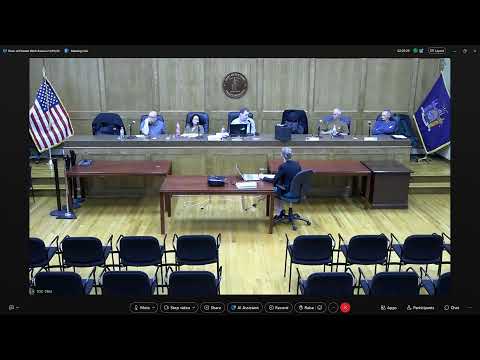
Chester work session advances draft zoning that would reintroduce religious, school uses in AR3 under case‑by‑case review
Summary
Town attorney presented draft zoning changes that would designate religious and educational uses as special‑use permits across the AR3 district — which covers roughly 70% of Chester — and require site‑specific SEQRA review; no formal vote was taken.
Town Attorney Liz presented the Town of Chester board with draft comprehensive plan and zoning amendments at a work session that would add a special‑use permit (SUP) process for religious and educational institutions in the AR3 agricultural‑residential district.
Liz told the board the purpose of the revisions is to align the code with state law and case precedent and to implement about 26 goals in the draft comprehensive plan. “The AR3 zoning district represents about 70% of your land masses,” she said, urging the town to adopt the comp plan first and then the zoning changes so the town can immediately begin implementation.
Why it matters: the 2017 local law removed religious and school uses from AR3 townwide and left many provisions without a clear procedure for review, turning existing facilities on some properties into nonconforming uses. Liz said she found no record that the 2015 comprehensive plan or the 2017 local law underwent the required SEQRA (environmental) findings or a negative declaration, a procedural omission that could expose prior actions to legal challenge.
Legal framework and proposed approach Liz reviewed New York Court of Appeals precedent, including Cornell University v. Bagardi, and federal protections under RLUIPA (the Religious Land Use and Institutionalized Persons Act), and recommended the town adopt an individualized SUP process rather than a blanket ban. Under the draft SUP language (proposed sec. 98‑31), applicants would face site plan review, a site‑specific SEQRA (environmental) analysis and objective findings on traffic, utilities, noise, buffering and emergency access before approval.
Liz said the SUP path lets planning bodies impose mitigation conditions — for example, limiting secondary drives or requiring traffic management — rather than excluding religious or educational uses outright. She described the SUP program’s renewal provision as an enforcement tool: permits can be time‑limited and not renewed if conditions are not met.
Camp Monroe and open‑space context The presentation addressed Camp Monroe, which Liz described as a long‑standing seasonal camp that predates zoning and therefore functions as a pre‑existing nonconforming use. She said there is no current application to expand the camp and that any year‑round conversion or expansion would require an SUP, site plan and a site‑specific SEQRA review plus upgrades to meet New York State building codes.
Liz also described recent open‑space acquisitions and tools: the town accepted roughly 13 acres from the Oakwood subdivision as town‑owned open space, and state legislation enabling community preservation funds could allow Chester to create a local fund (a transfer‑tax model was cited as three‑quarters of 1 percent in a nearby town) subject to a permissive referendum.
Board direction and next steps No decisions were made at the meeting. Liz said staff will post materials and circulate a redline of the draft zoning and comprehensive plan, a draft response to public comments and an expanded Environmental Assessment Form (EAF) to help the board decide whether a full environmental impact statement is necessary. She told the board she expects to deliver those materials ahead of the next meeting and asked for policy direction on a set of discrete points, including buffering standards, the role of the conservation advisory council, and clarifying the definition of “seasonal.”
What remains open: the legal review noted that the 2015 and 2017 records did not show SEQRA findings; the board will need to decide whether to accept an expanded EAF or declare a positive declaration and require an Environmental Impact Statement before proceeding. The town also must decide whether to place a community preservation fund before voters in a permissive referendum as required by state law.
The board is expected to receive the redline, the draft responses to comments and the expanded EAF in the coming weeks and to schedule further work sessions before any vote.