Get Full Government Meeting Transcripts, Videos, & Alerts Forever!
Get email alerts on the Active Transportation topic
No spam. Unsubscribe anytime.
Santa Barbara staff unveil updated Castillo and Haley bike‑and‑pedestrian plan, eye June 22 grant
Summary
City staff presented updated designs to raise bikeways through the Castillo undercrossing, add protected lanes on Haley Street, and widen sidewalks; they estimate roughly $15 million and say a grant application is due June 22.
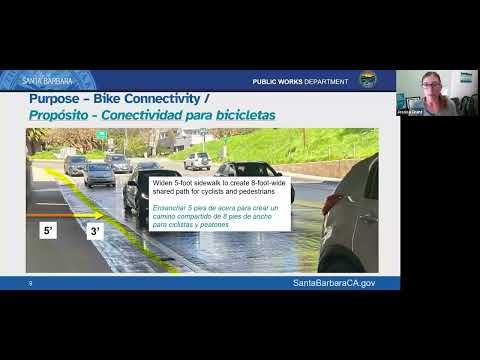
City of Santa Barbara staff on the evening webinar presented updated designs intended to improve walking and biking between downtown, the waterfront and Santa Barbara City College, including a raised bikeway through the Castillo Street undercrossing and protected lanes on Haley Street.
"The purpose of this project is to create safer walking and biking in the Castillo Street undercrossing area and at the approaches," Jessica Grant, a City of Santa Barbara staff member, said as she outlined the corridor limits from the Castillo/Montecito intersection down to Cabrillo Boulevard and into downtown.
Staff said the concept plan grew out of a multi‑year scoping process (2020–2024), community webinars and in‑person meetings and that City Council reviewed and supported the concept in April 2024 and authorized a new grant application cycle. The presentation noted an earlier statewide active‑transportation funding round had been highly competitive and that the current cycle has "a little over $300 million" in available funding.
On design details, staff described a roughly 200‑foot raised bikeway through the Castillo undercrossing to elevate cyclists above a persistently wet section; bridge abutments constrain available width to about eight feet, narrowing feasible design options. Staff said the team is considering either a shared path or separated 4‑ft/4‑ft treatments and that rebuilding the undercrossing would be far costlier (staff noted a full rebuild could exceed $100 million).
"The existing lanes are less than 10 feet each," Derek Bailey, the city's principal traffic engineer, said, explaining why the plan temporarily reallocates roadway space in one short block to widen remaining lanes and add a dedicated eastbound bike lane on Haley. Bailey said the approach is intended to improve maneuverability for vehicles while creating protected space for cyclists.
South of the Castillo/Montecito intersection staff described a scope change from an earlier two‑way multi‑use path to dedicated bike lanes on both sides where right‑of‑way allows. The plans use parking pockets and tree wells to separate cyclists from traffic; staff said there would be no tree removals on the Persian Park side and that some sidewalk widenings could require property acquisition on the east side.
Operational changes outlined include a short removal of one westbound lane immediately west of Bass Street to accommodate the bike lane (staff characterized the closure as brief and limited), and a one‑block conversion of Bath Street (south of Haley) to one‑way to improve intersection operations. Staff said the goal is to avoid losing on‑street parking on Haley, but that final tree‑well spacing and design decisions will determine whether any parking spaces are lost.
In response to a public question about cost, staff said a current ballpark estimate for the project is about $15 million, covering design, right‑of‑way phases and construction oversight; staff added estimates are being finalized to reflect cost escalation since earlier work. Staff also said they plan to apply for the current grant cycle and that the application deadline is June 22. If funded, the project would move to final design and, per staff comments, construction is anticipated around 2030–2031 (the transcript's exact wording was unclear).
On lighting and coordination, staff said they plan to infill lighting along the corridor and will need to coordinate undercrossing lighting details with a party named in the presentation as "CALR"; staff did not spell out that label during the webinar. Staff pointed participants to the recently completed Mila Street project as a precedent for sidewalk‑level bike lanes separated by a parkway and trees.
Public comments during the Q&A were largely supportive of protected bike lanes and wider sidewalks. One commenter described switching to an e‑bike and reducing driving by 70 percent, thanking staff for the safety improvements. City staff encouraged further feedback at an in‑person meeting the following day at the Haley/Delavina bridge and noted the city website lists mayor and council email addresses for comments.
Next steps: staff will hold an in‑person outreach session at the Haley/Delavina bridge, finalize cost estimates, submit the grant application by June 22, and — if awarded funding — proceed to final design and construction phases.