Get Full Government Meeting Transcripts, Videos, & Alerts Forever!
Get email alerts on the Strategic Planning topic
No spam. Unsubscribe anytime.
King City council workshop adopts consensus mission and vision drafts, prioritizes goals work
Summary
City council and staff held a League of Oregon Cities–facilitated strategic planning session June 3 that produced a council‑chosen mission and vision by group consensus, documented a SWOT analysis and scheduled goal‑setting work for the following day. Election filing details were shared.
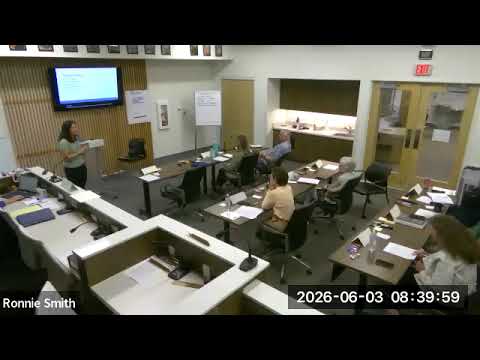
Jamie Pierce of the League of Oregon Cities opened King City’s June 3 strategic planning session and led councilors, the city manager and staff through a situational analysis, drafting exercises and consensus voting to produce a recommended mission and vision for the city. The two‑day workshop focused on identifying priorities, measurable objectives and realistic strategies for the next three to five years.
The session began with roll‑call introductions and ground rules emphasizing respectful discussion, timekeeping and a parking board for topics to address later. Pierce explained the workshop’s goals: a situational analysis, a mission statement, a vision statement, primary strategic goals and measurable objectives. Participants then completed a brief SWOT exercise; attendees repeatedly cited the city’s committed staff, new city manager, engaged residents and small‑town identity as strengths, and listed limited staffing, aging infrastructure and constrained finances as top weaknesses.
Council members and staff moved into a five‑step consensus process to draft a mission statement. After individual reviews of sample statements and three rounds of small‑group drafting and cross‑review, the group consolidated common words (safe, community, sustainability, responsive, well‑being) and voted with colored sticky dots. The most‑selected language became the working mission: “We are a city committed to promoting a safe, sustainable community and thriving future through effective and responsive governance.” Jamie Pierce and Robin Klein (League of Oregon Cities) synthesized the wording from the groups’ highlighted terms and facilitated the vote; councilors indicated they could “live with” and support the chosen phrasing.
Workshop participants used the same process to craft a vision statement. After group discussion and edits, the council selected a concise vision by vote: “We envision a flourishing and vibrant city with a strong sense of community where you can live, work and play.” Facilitators and councilors discussed word choices (for example, whether to use “promote,” “build” or “foster” in the mission) and adjusted language so mission and vision read as related but not duplicative.
The meeting also included an announcement about election filing: staff reminded potential candidates that they must be King City residents in the city proper (not the UGB) and reviewed filing deadlines and signature requirements for candidacy paperwork. City staff advised sending candidate materials to the city manager for distribution to avoid serial‑communication concerns during the work session.
Councilors flagged several recurring constraints that will inform goal setting, including restricted budget capacity and limited staff hours. City Manager Vinnie Ferrer emphasized the practical limits of implementation, asking the group to prioritize what staff should carry forward and to avoid overpromising. The facilitators instructed participants to bring the “goals: needs vs nuance” handout to the next day’s session to prepare for focused goal selection and objective drafting.
The workshop paused for lunch and resumed with vision refinement; after final adjustments and dot voting to select preferred phrasing, facilitators recorded the mission and vision as the workshop’s working statements. The group agreed to reconvene the following morning at 10 a.m. for goal setting, prioritization and drafting measurable objectives. A motion to adjourn was made and seconded; the meeting ended by voice vote.