Get Full Government Meeting Transcripts, Videos, & Alerts Forever!
Get email alerts on the Comprehensive Plan topic
No spam. Unsubscribe anytime.
Weston officials review survey, weigh housing, industrial growth and transportation as plan update begins
Summary
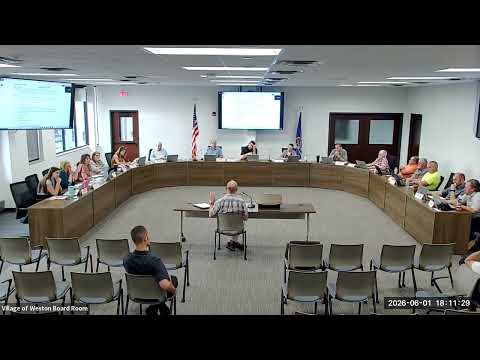
Consultant Mark Roers presented a 79‑page background report and survey results from nearly 700 respondents at a June 1 joint meeting of the Weston village board and planning commission. Officials flagged housing affordability, industrial development, road and interchange improvements, and parks as priorities for the comprehensive plan update.
Consultant Mark Roers told the Village of Weston village board and planning commission on June 1 that the comprehensive plan update is a year‑plus process and that the first phase — a community survey — produced nearly 700 responses to shape future policy.
Roers, who said he helped prepare Weston’s current zoning code and the 2016 comprehensive plan, described a comprehensive plan as a 10‑ to 20‑year guide for land use, transportation, utilities, housing and economic development. He reminded the board that the state requires municipalities engaged in land‑use regulation to update plans at least once every 10 years.
Roers summarized the survey’s broad themes: residents generally hold a favorable view of Weston, many are open to growth and change, and affordability — both taxes and housing costs — is a persistent concern. "There’s a lot of things that people like about the community," he said, while noting that responses are not uniform across all demographic groups.
Survey results presented to the joint meeting showed strong public support for industrial development and retail/commercial services; the survey also found more limited consensus around mixed‑use corridors. Respondents identified preserving natural areas, managing traffic impacts, reserving park land, creating jobs and protecting landowner rights among the top priorities when evaluating development proposals.
Trustees and commissioners used the meeting to surface priorities staff and the consultant should address in the policy (vision and directions) document. Gary (first name only) emphasized housing affordability and explored whether changes to regulations, fees or incentives could encourage starter homes and more affordable housing types. Multiple board members proposed leveraging industrial growth or a new TID-like vehicle to expand the tax base without proportionally increasing service costs: "We need industry that brings jobs and tax base," one trustee said.
Transportation and access were recurring topics. Several members highlighted a possible interchange at Ryan Street to divert heavy truck traffic from Camp Phillips Road; Roers and trustees noted an interchange would be costly but said the state Department of Transportation could fund right‑of‑way and maintenance if it approved an interchange. Board members described the Ryan Street option as high impact but capital‑intensive and recommended staff explore feasibility and state coordination.
Roers also called attention to developable land inside current village limits (about 2,300 acres, he said) but cautioned that not all parcels have utilities or are immediately developable. He outlined annexation options (incremental, negotiated intergovernmental approaches, or merger) and recommended coordination with the neighboring town, which is updating its plan in parallel.
Public‑service metrics from the survey showed EMS, fire and police rated highest for importance; satisfaction remained relatively high for those services, while satisfaction with road maintenance lagged behind perceived importance. Roers recommended clarifying which roads are under village control versus county or state responsibility as the plan prioritizes infrastructure work.
Roers said staff plans to reconvene the group in August with an initial outline for the vision and directions volume and to hold an open house or workshop in September 2026 to broaden community feedback.
Why it matters: The plan will shape where housing and businesses can be sited, how road and utility investments are prioritized, and how Weston balances its stated preference for controlling property taxes with support for business and housing that expand the tax base. The board’s early consensus around housing affordability, industrial growth and targeted transportation projects gives staff a set of priorities to frame the next draft and stakeholder outreach.