Get Full Government Meeting Transcripts, Videos, & Alerts Forever!
Get email alerts on the Default Budget topic
No spam. Unsubscribe anytime.
Budget committee briefs on SB2 default budget rules and legal uncertainty over contracts
Summary
Brentwood's budget committee reviewed how SB2 changes default-budget calculations, highlighting statutory language (RSA references) that only contracts previously approved by the legislative body (voters) may be carried into a default budget — creating uncertainty for multi‑year service agreements signed by select boards.
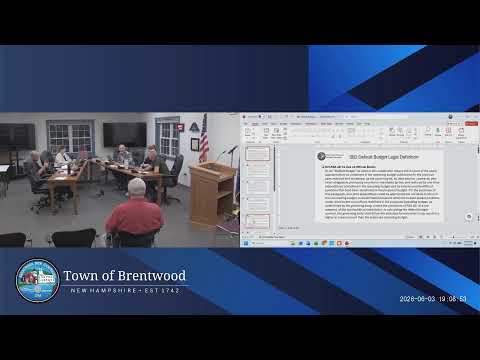
Brentwood’s Budget Committee spent a substantial portion of its June 3 meeting reviewing how the SB2 form of local government affects the town’s default budget and which prior-year obligations can be carried forward.
The committee’s presenter walked members through RSA provisions that define a default budget as the previous year’s appropriations adjusted only for specific items such as debt service and legally mandated obligations. He noted the statutory change requiring that contracts included in a default calculation must have been “previously approved by the legislative body,” meaning voters, not only the governing board.
That contractual requirement was the focal point of committee discussion. Members raised examples — municipal trash and waste contracts, school bus contracts with escalator clauses, and recent employment contract terms — and queried whether those would qualify as prior-year contractual obligations if the contracts had not been approved on a warrant article by voters.
“Employee raises should not be included in the default budget unless they are required by a legally binding and previously ratified contract obligating the municipality to fill particular positions or employ particular people at certain wages,” the presenter read from NHMA guidance cited in the meeting.
Committee members asked the town attorney to clarify how to treat existing multi-year vendor agreements (the meeting cited a local Cassella trash contract that was signed by the select board) and whether voters’ prior approval of a general operating budget that contained the appropriation could be interpreted as approval of future-year contractual escalators.
The committee reviewed a Fremont MSDTB default-budget form as a working example and agreed that legal guidance is necessary before finalizing Brentwood’s approach. Members noted HB575 — pending legislation that would make the municipal budget committee responsible for preparing the default budget in SB2 communities — and said the bill, if enacted, would change certification procedures but does not itself resolve the contractual ambiguity.
Next steps: committee members asked staff to coordinate with the town attorney and NHMA, to prepare a list of current town contracts for legal review, and to ensure the MSDTB form and accounting entries are completed transparently before ballots are printed.