Get Full Government Meeting Transcripts, Videos, & Alerts Forever!
Get email alerts on the County Budget topic
No spam. Unsubscribe anytime.
Multnomah County chair unveils difficult FY2027 budget, prioritizes eviction prevention and housing exits
Summary
County Chair Vega Peterson presented a $93.2 million smaller FY2027 executive budget that cuts administrative overhead but includes $3.5 million for eviction prevention, $10 million to move people from shelter into housing, and one‑time funding to support shelter ramp‑downs amid planned bed reductions.
Multnomah County Chair Vega Peterson on the board floor presented the proposed fiscal year 2027 executive budget, describing it as the most difficult of her tenure and saying the county faces a $93.2 million reduction from last year and an $11 million general‑fund shortfall.
Peterson said the budget prioritizes direct services and contains targeted investments in housing transitions: "This budget invests in the county's eviction prevention system, adding $3.5 million in combined general fund and SHS funding," she said, and it also "dedicates $10 million in funding to services that can help people move from shelter to housing faster." The chair said a $67 million funding gap in homeless services — driven by reduced revenues from the supportive housing services measure, loss of one‑time funding, and city contributions — required tradeoffs.
To manage the change, Peterson announced plans to close shelter beds after reviewing facility conditions and outcomes, and included $1.8 million in one‑time SHS funding to support program ramp‑downs. "These shelter cuts will be painful," she warned, and said the transition funding will focus on engagement with staff and shelter guests to move people into housing or other shelter locations.
The chair also outlined broad reductions and protections across county programs. She said the public‑health budget faces a near $29 million reduction but that core public‑health infrastructure and 18 community clinics would be maintained. The budget fully funds Corrections Health programs including the Stabilization and Readiness Program (SARP) and preserves jail operations while seeking administrative savings through a 6% constraint on internal services.
On children and families, the proposal dedicates $11 million toward school‑based mental‑health and SUN program continuity and backs Preschool for All expansion to about 7,000 seats. The budget maintains library capital bond work and funds ranked‑choice voting implementation for county elections.
County Budget Director Christian Elkin said the proposed budget document and program dashboards were posted online for public review and described a seven‑week review and three public hearings; he said the board will vote to approve the budget on April 23 before submitting it to the Tax Supervising and Conservation Commission (TSCC).
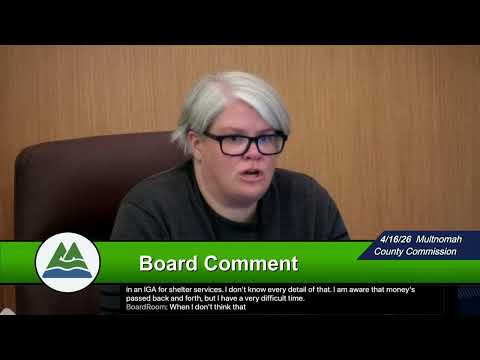
Commissioners responded with a mix of support and concern: several members emphasized protecting frontline staff and services, sought more detail on transition plans for shelter closures and the $1.8 million ramp‑down funding, and urged close coordination with the City of Portland and other partners around homelessness funding and program continuity. The chair characterized the presentation as a starting point for a deliberative process over upcoming work sessions and hearings.
The board took no vote on the presentation; the item was informational and will return for deliberation and action during the budget process.