Get Full Government Meeting Transcripts, Videos, & Alerts Forever!
Get email alerts on the Municipal Budget topic
No spam. Unsubscribe anytime.
Lawrence CAFO outlines FY27 budget with $1.8M health insurance jump, debt tied to new schools and police station
Summary
The city’s CAFO presented a FY27 budget that balances rising costs and limited revenue growth, noting an $1.8 million (11%) rise in health insurance and roughly $132 million borrowed for two new schools and a police station; the presentation laid out levy mechanics and estimated a $1.4–1.5 million new-growth boost.
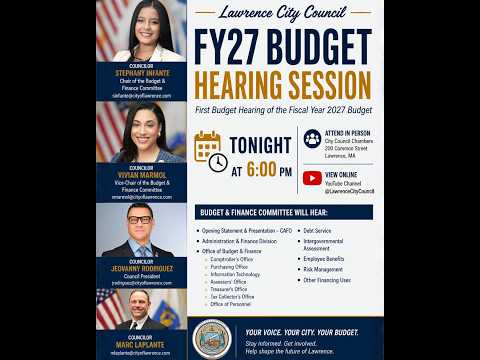
Ramona Sabajos, the city’s chief administrative and financial officer, presented the recommended FY27 municipal budget to the Lawrence City Budget & Finance Committee on June 1, citing rising insurance and borrowing costs as the most significant pressures. She told the committee that “health insurance expenses increased by $1.8 million or 11% over last year,” and that the city carries large recent borrowings tied to new school projects and a police station.
Sabajos said the administration developed a balanced budget despite constrained revenue growth, noting that the city financed two new schools and the new police station through approximately $132 million in borrowing without a Proposition 2½ override or debt exclusion. She told the committee the FY27 debt service totals $14,919,772; roughly $7.69 million of next-year principal and interest relates to the Oliver and Leahy school loans and the police station.
The presentation summarized how the tax levy is computed under Proposition 2½, including the 2.5% allowable increase and ‘‘new growth’’ additions. The assessor’s office estimates new growth for FY27 at roughly $1.4–1.5 million, which the CAFO said, if realized, would modestly increase the city’s levy capacity. Sabajos also noted the city currently has about $13.1 million in excess levy capacity.
On revenue composition, Sabajos walked the committee through the four main revenue sources—property taxes and excise, state aid, local receipts and other financing sources—and explained that other financing sources include indirect cost charges tied to enterprise funds as well as debt proceeds tied to school and police projects.
Council members pressed for additional detail in several areas, including the timing of the tax-rate setting (the CAFO said the city will revisit tax-rate impacts at the November tax-rate setting) and the composition of debt-service amortizations. The CAFO said amortization schedules are available and that the administration could provide more detail to the council on request.
The next procedural step is the continuing FY27 hearings; the chair scheduled follow-up departmental presentations for the committee’s next meetings.