Get Full Government Meeting Transcripts, Videos, & Alerts Forever!
Get email alerts on the Memorial Signs topic
No spam. Unsubscribe anytime.
Marysville council advances draft memorial-sign program; staff to return final proposal for vote
Summary
Council discussed a draft memorial-sign program that would allow family members or household members to apply for roadside memorial signs on Marysville streets (not state highways), require incident verification and a 45-day site inspection, limit displays to seven years, and include a projected fee to cover costs; staff will refine the draft and return it for a vote next week.
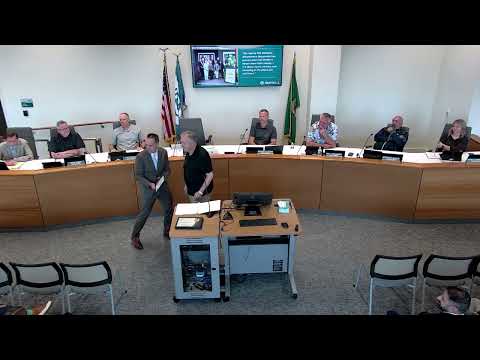
Marysville’s City Council reviewed a draft memorial-sign program on June 1 and asked staff to return a revised version for formal consideration next week.
Tara Meiselle, the city’s parks, culture and recreation director, told the council the program is intended to provide “equal care for every family” seeking roadside memorials. Under the draft, eligible applicants would be an immediate family member or a person in the same household; the incident must have occurred on a Marysville street within the prior five years and cannot be the result of a law-enforcement action by or against the decedent, Meiselle said.
The draft lays out an application and verification process: applicants must submit incident reports (online or in person), the city will acknowledge applications within 20 days, and staff will perform a site inspection within 45 days. Proposed sign specifications include a 24-by-24-inch sign with retroreflective lettering and up to three plaque entries; the city projects a seven-year display period and expects to set a fee to cover installation and maintenance (staff estimated roughly in the $400–$500 range while costs are refined).
Council members raised questions about several operational details. Council Member Candelius asked whether signs could be installed on state highways; staff replied no, the program would apply only to Marysville-owned streets and that state or county programs cover those arterials. On family disputes, Meiselle said the city will not install a memorial if an immediate family member has submitted a written objection: "if a family is in discord ... that would not be our role," she said, adding the policy relies on families to resolve internal disagreements.
Council Member James pressed on the policy’s exclusion for incidents involving law enforcement, asking how the rule would apply to single-vehicle crashes or impaired drivers. Meiselle agreed that impairment-related incidents could disqualify an applicant under the current draft. Members also asked who would pay to replace signs damaged by vandalism or collisions; the draft places replacement responsibility with the applicant, though some council members suggested the city consider covering certain replacements.
Meiselle said staff will clearly notify applicants that the application is a public record and that the city will track sign lifecycles using an internal schedule to alert families before the seven-year period ends. The council offered clarifications on spacing, alternative memorial options (such as park benches), and an administrative appeals path to the city administrator.
Mayor Nearing and council members indicated they had sufficient direction for staff to incorporate changes and asked that a final version be returned to the council for a formal vote next week. The council did not adopt the program at the work session; staff will present an updated draft with clarified language on eligibility, fees and maintenance responsibilities for consideration at the upcoming voting meeting.