Get Full Government Meeting Transcripts, Videos, & Alerts Forever!
Get email alerts on the Neighborhood Retail topic
No spam. Unsubscribe anytime.
Kenmore planning panel directs staff to draft neighborhood‑retail rules after public input; debates hours, signs and parking
Summary
Planning commissioners heard staff survey results showing strong support for small eating/drinking venues and specialty shops, gave direction to allow neighborhood retail in R4–R24 with 2,500‑sq‑ft scale limits, and asked for more data on traffic, freestanding signs and enforcement before draft code is prepared for public hearing.
The Kenmore Planning Commission on June 2 reviewed staff recommendations to permit neighborhood retail across much of the city’s residential zones and gave staff direction to return with draft code this summer and a public hearing in the fall.
Britney, community development staff, summarized the city’s outreach and findings: “Our first survey received 190 responses,” she said, adding that a second, finer‑grain survey and two open houses brought total engagement to about 200 people. The top uses preferred by residents were eating and drinking establishments, specialty shops and neighborhood markets, with recurring themes of walkability, mixed‑use flexibility and access to daily needs.
Why it matters: Commissioners framed the proposal as an incremental step toward more walkable neighborhoods while trying to limit potential negative effects on adjacent homes. Staff proposed several guardrails — a 2,500‑square‑foot maximum for a single establishment, hours of operation of 6 a.m. to 10 p.m., no minimum parking in R4–R24, and a permitting approach that generally treats conversions as type‑one reviews unless conditional or environmental issues require a type‑two decision.
Debate over hours and scale: Commissioner Thompson urged caution on the evening closing time, saying a 10 p.m. closing could increase street traffic and late‑night noise for neighbors and preferring a 9 p.m. limit. “I could see that that could be disturbing to a neighborhood,” Thompson said. Other commissioners said the city’s noise ordinance provides an existing enforcement tool and were comfortable with the 6 a.m.–10 p.m. window but agreed the hours could be revisited if complaints grow.
Signs and lighting: Commissioners pressed staff for specific sign rules. Staff demonstrated A‑frame and wall‑sign sizes and asked whether the commission preferred a 6‑sq‑ft or 25‑sq‑ft wall‑sign standard. Commissioners supported keeping the existing A‑frame allowance (6 sq ft) and discussing freestanding pole signs further. Several members asked staff to return with case studies and suggested constraints on height and downward‑directed lighting to reduce neighborhood impacts.
Permitting, enforcement and conversions: Staff clarified an earlier packet error about permitting and explained that many conversions from residential to commercial use would be handled as type‑one reviews, while conditional uses and environmental reviews remain type‑two. Commissioners asked who enforces sign and hours rules; staff said code compliance officers and, for right‑of‑way conflicts, public‑works staff respond, but most enforcement is complaint‑driven and not 24/7.
Traffic and parking: Concerned commissioners asked staff to compile trip‑generation and pedestrian‑count data from other cities and regional sources to better estimate vehicle, delivery and pedestrian impacts in residential areas. “I’m not asking you to do original research, just to look up standardized trip‑generation numbers and comparable cases,” Commissioner Thompson said.
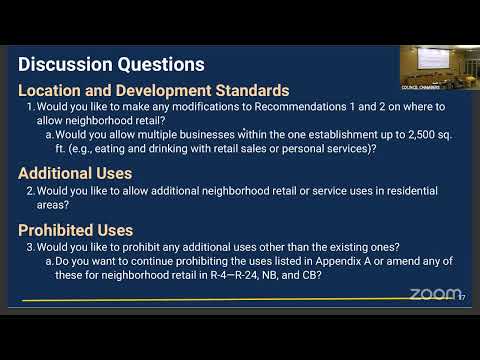
Which businesses would be allowed: Staff proposed permitting eating/drinking (but prohibiting bars/nightclubs in residential zones), specialty shops, neighborhood markets, fitness/recreation (gyms/fitness studios), personal services (barber/beauty, clothing alterations, photo studios) and artist studios, generally capped at 2,500 sq ft in R4–R24. Commissioners supported allowing restaurants that serve alcohol where the establishment is food‑driven, while maintaining a prohibition on drinking places (bars/taverns/nightclubs) in residential zones as currently coded.
Public‑health and retail mix: Several commissioners urged the city to avoid encouraging convenience‑store models that rely heavily on alcohol or tobacco sales and to consider incentives for fresh‑food options (corner markets) rather than small‑box or dollar‑store formats. Staff said they would explore definitions and potential incentives, and check industry classifications and FDA/Census definitions to help draft appropriate code language.
Next steps and votes at a glance: Commissioners directed staff to prepare draft code changes this summer, bring sign case studies and comparative trip‑generation data, and return to commission ahead of a public hearing in the fall. Procedural votes recorded: the consent agenda was approved by unanimous consent early in the meeting; later, a motion to extend the meeting 15 minutes (to 10:15 p.m.) was moved, seconded and approved by unanimous voice agreement.
What remains unsettled: Key outstanding items the commission asked staff to return with are (1) sample code language and case studies for freestanding/pole signs and lighting standards, (2) trip‑generation and walkability data tied to different neighborhood retail types, (3) clarification of how accessory commercial units (ACUs) and home‑occupation rules would interact with neighborhood retail allowances, and (4) draft parking guidance for home‑occupation versus neighborhood‑retail cases.
The commission did not adopt final code tonight; staff said draft code will be prepared for the commission’s summer meeting with a public hearing and council recommendation planned for the fall. The meeting adjourned at 10:12 p.m.