Get Full Government Meeting Transcripts, Videos, & Alerts Forever!
Get email alerts on the Education Curriculum topic
No spam. Unsubscribe anytime.
Mars Area SD curriculum leaders highlight alignment, high acceleration rates and needs in specials
Summary
Curriculum leaders reported coordinated standards mapping, monthly co-planning and a record science fair; secondary math leaders said about 85% of students are in accelerated pathways and the district will add a high‑school pre‑algebra course next year to support students, while specials staff raised space and scheduling concerns.
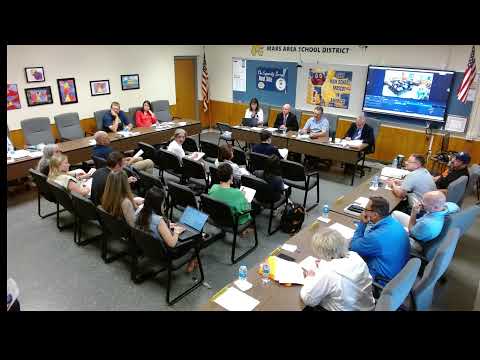
Curriculum leaders at the Mars Area School District presented a year‑end report to the school board, highlighting districtwide efforts to align instruction and expand accelerated math pathways while flagging capacity concerns in specials and health instruction.
Dr. J King, a sixth‑grade English language arts teacher and curriculum leader at Centennial, said teachers have used scheduled collaboration time to co‑plan and align resources with the district’s curriculum maps. "This collaboration leads to a professional community where teachers are learning from each other and the focus is on the growth of the students," Dr. J King said, describing how teams use PSSA and AIMweb data to target instruction and reteach where needed.
Tommy Anderson, Centennial’s fifth‑ and sixth‑grade gifted coordinator, said the district created unified standards maps and shared Schoology group pages that allow teachers to access and edit common materials. Anderson said those materials supported monthly co‑planning and helped organize the Centennial science fair, which he said drew "over 30" student entries this year.
Joe Graph, the district’s 7–12 math presenter, said the secondary program now runs three pathways — traditional, accelerated and an accelerated/AP pathway — and that roughly "about 85% of our students are in some sort of accelerated pathway." He added that the accelerated/AP option will cover a larger portion of the incoming seventh‑grade class next year (he estimated about 30%) and that the district plans to add a high‑school pre‑algebra course to give students who are not ready for Algebra I a clearer route.
Aaron Bridge, who oversees K–12 specials including library, art, music, physical education, STEAM and world language, described mapping the specials curriculum and creating shared online resources so teachers across buildings can access consistent materials. Bridge flagged a capacity issue for health instruction, saying growing class sizes and limited available rooms may complicate scheduling next year, and said some departments would like to begin instrumental instruction earlier than sixth grade.
Board members thanked the presenters and discussed next steps; curriculum leaders said work on mapping, assessments and professional development will continue into the coming year. No formal board action on curriculum programs was taken at the meeting.
The presentations emphasized continued district attention to vertical alignment, measurement of student progress and targeted interventions for students who fall behind in state assessments.