Get Full Government Meeting Transcripts, Videos, & Alerts Forever!
Get email alerts on the Justice Center topic
No spam. Unsubscribe anytime.
Officials present budget scenarios as Bellingham area weighs jail and behavioral care center tradeoffs
Summary
Wakom County and Bellingham officials presented four budget-and-scope scenarios for a combined jail and behavioral care center, warned rising construction costs and weaker sales-tax receipts have shrunk available funding, and asked elected officials for policy guidance ahead of an April decision deadline.
Deputy County Executive Kayla Shot Breler told the Public Health, Safety, Justice and Equity Committee that Wakom County and the City of Bellingham are in a validation phase for a proposed Wakom County Justice and Behavioral Care Center and need policy direction on scope and budget before entering architectural design.
"We have some really big decisions coming up on the scope and budget for this capital project," Shot Breler said, adding the county aims to have decisions on scope and budget by the end of April so design can begin in summer 2026. She described a progressive design-build procurement and said the county is coordinating with cities through an interlocal agreement and with the sheriff's office, advisory boards and the public.
Officials presented four scenarios, each modeled at a 480-bed baseline used for apples-to-apples comparison. Scenario one is a $170 million, budget-driven model with limited programming; scenario two targets $200 million and adds operational and programming space; scenario three increases capacity for classification flexibility and rehabilitative services; and scenario four is a more integrated justice model with advanced behavioral-health treatment.
Shot Breler cautioned that bed count alone does not resolve booking restrictions. "Eliminating booking restrictions is far more complex than simply the number of beds," she said, pointing to housing configuration, classification flexibility and diversion work outside the jail as major drivers of usable capacity and of operational cost.
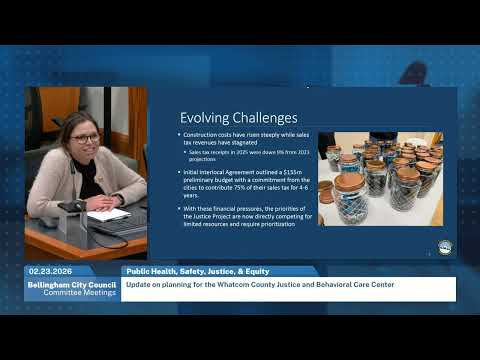
She also described financial pressure: construction costs have risen since 2023 and sales-tax receipts have lagged earlier projections. Shot Breler said initial planning used a $155 million capital estimate and expected a 4% sales-tax growth, but cited a 9% shortfall in 2025 versus 2023 projections and recent growth nearer 1.5 percent.
Council members asked detailed questions about the scenarios. One asked whether an $8 million demolition expense could be deferred; Shot Breler said deferral was "on the table." Members pushed back on both risks: underbuilding could prolong booking restrictions and raise long-term operational costs, while overbuilding would strain municipalities' budgets.
Council members and the mayor discussed options to phase or modularly expand the facility and how investments in diversion, expedited court processing and community-based services could reduce bed demand. Mayor Kim London said the sheriff has expressed that a 600-bed capacity is preferable for future needs, though the presenters used 480 as a working baseline.
Shot Breler said the county will refine capacity and behavioral-health analyses in the coming weeks and return to elected officials and advisory boards for policy direction. The county council will have final budgeting authority; the interlocal agreement members must also agree on any updated financial framework.
Next steps include outreach with advisory boards, continued analysis of average length of stay and bed-configuration impacts, and a decision timeline to inform the design-build team's programming and pricing work.