Get Full Government Meeting Transcripts, Videos, & Alerts Forever!
Get email alerts on the Economic Development topic
No spam. Unsubscribe anytime.
Port of Bellingham outlines 2027—631 regional economic development goals, flags infrastructure and workforce priorities
Summary
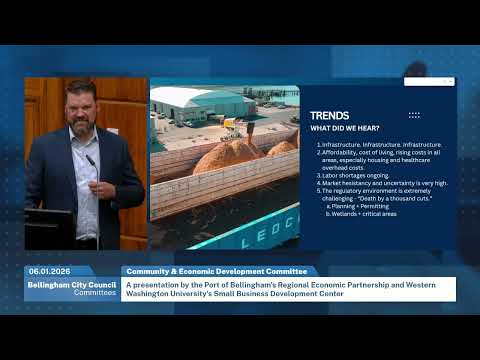
The Port of Bellingham presented its 2027—631 comprehensive economic development strategy (CEDS) update to the City of Bellingham committee, highlighting infrastructure, workforce pipelines and steps to attract and expand local firms such as PureBlue Tech.
The Port of Bellingham told the City of Bellingham's Community and Economic Development Committee that its 2027—631 comprehensive economic development strategy will prioritize infrastructure, business vitality, workforce and resiliency.
"We want to have a coordinated effort moving forward," Tyler Schroeder, the port's director of economic development, told the committee. Schroeder said the port is focusing on measurable action items and anticipates identifying leads for each action by the end of the year before seeking county council approval.
Schroeder described a recent business expansion the port helped broker: PureBlue Tech moved from a 10,000-square-foot site to larger waterfront space, a three-way agreement that may allow the port to acquire the property, become a landlord and support the company's growth from roughly 10 employees toward 50—60. "We were able to 'work with the owner of the old Silfab building' and the Port of Bellingham's real estate team," Schroeder said, using the deal as an example of retention and expansion work.
The presentation also outlined partnerships to strengthen the local food economy. Schroeder described the port's role with Whatcom Food & Farm Station (acquired from the former Box Berry Farm) and noted the importance of cold storage and processing infrastructure that connects county agriculture to Bellingham's waterfront logistics.
On industrial land, Schroeder said the port's industrial land study confirms limited available land along freight corridors countywide and urged coordination with the city and county comprehensive-plan processes. "The industrial lands along freight corridors is limited in our community," he said, and the study offers recommendations on vacancy rates and property sizes for larger industrial facilities.
Workforce development was a recurring theme. Schroeder described Blu-Tech by the Bay, a port partnership event that brought about 120 high-school students to meet maritime employers and training partners, and emphasized welding, marine manufacturing and cross-sector career pipelines.
Schroeder reported public engagement for the CEDS update included approximately 617 responses and roughly 75 interviews with public officials plus about 45 private-sector interviews. He said the port incorporated tribal perspectives from Lummi Nation and Nooksack Tribe into the countywide strategy.
The committee did not take formal votes. Council members pressed staff on implementing tools to lower downtown vacancy and on how the port will coordinate CEDS action items with city planning, county comp-plan language and freight/transportation partners. Schroeder said the port will continue coordination with city and county planning staff and the county council as the strategy progresses.
Next steps: the port expects to finish action-item assignments within the year and present the final CEDS for county approval as a roadmap for five years of coordinated economic development efforts.