Get Full Government Meeting Transcripts, Videos, & Alerts Forever!
Get email alerts on the Grants Research Forensics topic
No spam. Unsubscribe anytime.
NIJ opens FY25 forensic-science research NOFO with $2 million; Grants.gov SF-424 due June 2, JustGrants full application due June 9
Summary
The National Institute of Justice announced a FY25 Notice of Funding Opportunity worth $2 million for research and evaluation of forensic science systems, inviting proposals in three priority areas—impact, method implementation/admissibility, and workforce development—and outlining application requirements and a two-step Grants.gov/JustGrants submission process.
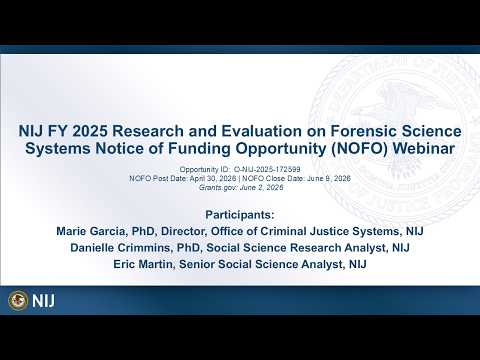
The National Institute of Justice on a webinar announced a FY25 Notice of Funding Opportunity (NOFO) offering $2 million for research and evaluation projects that assess the role, implementation and workforce implications of forensic science in the criminal justice system. Marie Garcia, director of the Office of Criminal Justice Systems at NIJ, said the program “seeks to advance understanding of the impact of forensic science on the criminal justice system, evaluate and assess the admissibility of new and innovative forensic science methods and research to assist in the development of the forensic science workforce.”
The solicitation targets three topic areas: (1) the impact of forensic science on criminal justice outcomes such as investigative clearance rates and lab backlogs; (2) evaluations of implementation and courtroom admissibility for new forensic methods; and (3) research into workforce needs, training, recruitment and retention. Danielle Crimmins, a social science research analyst at NIJ, said the NOFO will consider only applications aligned to those three areas and that “applications for research and evaluation on topics outside of the three priority areas will not be considered responsive to this NOFO.”
Prospective applicants must follow a two-step electronic submission process. Eric Martin, senior social science analyst at NIJ, explained that applicants first submit an SF-424 in Grants.gov (recommended at least 48 hours before the deadline) and then complete the full application in the Department of Justice’s JustGrants system. Crimmins highlighted the two deadlines: the SF-424 in Grants.gov is due June 2 and the full JustGrants application is due June 9.
The NOFO includes specific expectations for evaluation research. Crimmins said evaluation proposals should use “the most rigorous evaluation design appropriate for the research questions,” include implementation-fidelity measures and allow interim feedback to program providers; for evaluation studies, applicants must also include a cost-benefit and cost-effectiveness analysis. NIJ clarified that the NOFO does not fund training or technical assistance; applicants seeking those activities should consult Bureau of Justice Assistance (BJA) or other OJP funding opportunities.
Applicants must have an active Sam.gov registration and a unique entity identifier before submitting an SF-424; Martin emphasized that “applicants who do not have an active Sam.gov status will not be able to complete step one of the application process in Grants.gov.” He also urged organizations to keep Sam.gov points of contact current so required notices and onboarding steps for JustGrants are received.
Required application components to pass initial screening include an SF-424, a project narrative (30-page limit for the narrative), a budget and budget narrative, and CVs or resumes for key personnel. Martin said applications failing to meet these basic minimum requirements will be eliminated before peer review. For evaluation and research proposals, reviewers will assess technical merit, geographic diversity and past performance; high-scoring applications receive external peer review comments and then are considered by NIJ staff, who make funding recommendations to the NIJ director. Garcia noted that the director has sole discretion on final awards.
Several common procedural clarifications were addressed in the webinar: R2-designated universities are eligible to apply provided they have an administrative office able to submit and manage a federal grant; digital forensics projects are eligible within the three topics; a memorandum of understanding is not required at submission but may be needed if data access from law enforcement or other agencies is necessary; IRB approval is not required at the time of submission but applicants should be transparent about archiving limitations; and the anticipated award period for projects is 36 months.
On administrative details, NIJ advised applicants to avoid including personally identifiable information in the public proposal abstract, to follow the NOFO’s formatting guidance (double-spacing preferred for legibility), and to consult the NOFO pages referenced in the webinar slides for detailed instructions. NIJ will post slides and the recorded webinar on NIJ.gov and attendees were directed to the OJP Response Center, Grants.gov and JustGrants support resources for additional technical assistance.
The webinar closed with a request that any questions not resolved during the session be submitted to the OJP Response Center. Marie Garcia said the program team looks forward to reviewing applications and reiterated that funding decisions will reflect application merit, alignment with NOFO objectives and available funds.