Get Full Government Meeting Transcripts, Videos, & Alerts Forever!
Get email alerts on the Invasive Plants topic
No spam. Unsubscribe anytime.
Invasive plant biologist Chad Hammer outlines early-detection priorities and treatment options
Summary
Chad Hammer, invasive plant biologist with the Natural Areas Program at the Department of Agriculture, Conservation and Forestry, described prioritization strategies (eradicate outliers, protect upstream and special habitats), treatment options (mechanical, herbicide, tarping), permitting needs near water, and the need for long-term monitoring and revegetation.
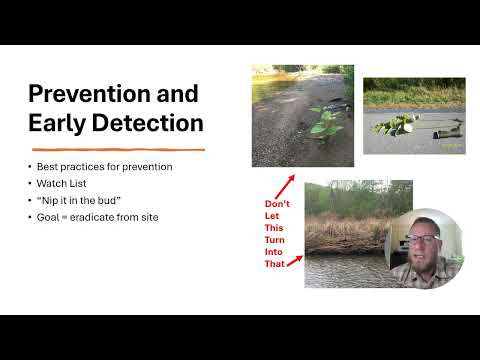
Chad Hammer, invasive plant biologist with the Natural Areas Program at the Department of Agriculture, Conservation and Forestry, urged land managers to prioritize early detection and rapid response to invasive plants and to focus first on small, isolated populations that can seed broader infestations.
"Prioritize isolated populations first and then work toward the core," Hammer said, explaining that treating outliers and upstream patches reduces downstream propagule pressure and limits future spread. He framed early detection as the most cost-effective stage for control: "When time is near Time Zero that's when...eradication is still possible," he said.
Hammer outlined two complementary prioritization approaches: a species-based approach that considers a plant's biology (phenology, dispersal rate and impact), and a site-based approach that emphasizes outlier populations, special habitats and high-dispersal corridors such as streams, trails and harvesting sites. He said a species may be categorized as "localized" when it is present in fewer than eight counties in the state, which can raise its priority for eradication in that jurisdiction.
On methods, Hammer described mechanical removal (hand-pulling, cutting), tarping/solarization, and herbicide options. He cautioned that mechanical removal can cause soil disturbance and erosion and that some mechanical strategies require repeated effort ("often five to eight times per year for five years" for some perennial species). For tarping he said geotextile or heavy plastic left in place for multiple years (commonly five to 10) can suppress plants but requires edge monitoring to catch resprouts.
On chemical controls, Hammer recommended consulting licensed applicators and tailoring treatments to species phenology and site conditions. He described targeted applications such as cut-stump and basal-bark treatments that minimize off-target exposure and explained systemic herbicides (for example, triclopyr and glyphosate) are often used to translocate treatment into root systems. He advised minimizing drift by spraying toward the ground and avoiding applications when wind speeds exceed 10 miles per hour.
Hammer warned that applying herbicides near water can trigger additional permitting requirements: "You may need a permit from the Army Corps of Engineers or the EPA for waste discharges," he said, and noted some municipalities or pesticide-control boards can require variances or permits. He reiterated that licensed commercial applicators are a recommended resource for compliance and safety.
He emphasized that management rarely ends with a single treatment: seed banks and strong below-ground structures can produce resprouts and germination years after removal, so persistent monitoring and rapid removal of new shoots are essential. Where feasible, Hammer recommended revegetation with fast-establishing native species or seed mixes to occupy niche space and build bioresistance against reinvasion.
Hammer closed by pointing to tools and resources for managers, including the state invasive plant field guide and iMapInvasives for distribution data, and cited organizations such as Native Plant Trust and New England Wetland Plants as sources of native seed mixes and planting guidance. He provided contact information for follow-up questions.