Get Full Government Meeting Transcripts, Videos, & Alerts Forever!
Get email alerts on the County Budget topic
No spam. Unsubscribe anytime.
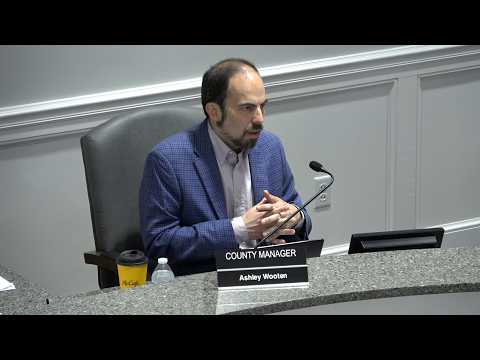
McDowell County manager presents FY27 budget, proposes 2% COLA and no tax-rate increase
Summary
County manager Mr. Wooten presented the recommended FY27 budget, proposing a 2% cost-of-living adjustment for employees, maintaining the current property tax rate (presented in materials as 0.5675), using a fund-balance appropriation to balance the plan, and scheduling a public hearing for June 15 with final action expected June 30.
McDowell County Manager Mr. Wooten presented the recommended fiscal year 2027 budget and asked the board to hold a public hearing on June 15 and consider final approval on June 30. He said the proposal preserves existing service levels, includes a 2% cost-of-living adjustment for county staff and maintains the county's current property tax rate (presented in the meeting materials as 0.5675).
Why it matters: the proposed budget tries to balance rising operating costs and public-safety needs while limiting the direct tax impact on residents. Mr. Wooten told commissioners the plan funds recurring operating needs, begins the year with more fully budgeted health-insurance costs and relies in part on an appropriation of fund balance to close the gap between requests and available revenue.
Mr. Wooten detailed the largest expenditure pressures: an estimated year-over-year health insurance cost increase of about 3%, a roughly $600,000 increase in emergency-services and sheriff's office costs, and sharply higher fuel expenses (he estimated diesel-related fuel costs roughly 30% higher than the prior period, given county consumption patterns). He said the recommended budget includes a 2% COLA and does not change the property tax rate; growth in the tax base, not a rate increase, produces the revenue rise shown in the presentation. "This is their budget too," he said, describing the need to show taxpayers how county services are funded and prioritized.
Funding choices and one-time vs. recurring items: Mr. Wooten explained the recommended use of fund balance to balance the budget and cautioned commissioners that the appropriation would be recurring if adopted. He noted peer counties maintain larger reserve levels and said that, with the proposed appropriation, McDowell County's available fund balance would be about 32% (he referenced roughly $35 million as a 50% peer benchmark), and warned that lower reserves leave the county exposed to disasters like Helen.
Program-specific items: the proposed FY27 budget includes a roughly $1.8 million transfer from the general fund to the solid-waste fund (a gap some peers cover with household trash fees), continued support for human-services consolidation under the county's human services director (Miss Brewer), ongoing water-system projects (including a storage tank and an AIA asset inventory/rate study) and park improvements funded in part with state grants and American Rescue Plan Act dollars. Mr. Wooten said McDowell received about $580,000 in EPA-related funding (through a state channel) to improve cardboard and recycling handling at convenience centers.
Federal and state policy impacts: Mr. Wooten highlighted a federal legislative change he referred to as HR1 that shifts part of the administrative cost for food-nutrition services to nonfederal entities and estimated that change could cost the county about $365,000; he said he had contacted the county's state delegation and that the matter was under review. He also urged commissioners to plan for possible state property-tax reform measures and to advocate for fairness if levy limits or other reforms proceed.
Capital and staffing pressures: Mr. Wooten said most capital debt cited in the presentation is for vehicle replacements and equipment, and he reiterated long-standing facility needs: the 911 center is out of space, DSS facility needs remain expensive (previous estimates for a new building were $25—30 million), and animal services requires improved space. He noted a $1.5 million congressional appropriation from Congressman Edwards toward 911 work but said the center likely needs an additional $3—4 million to complete construction. On staffing, he recommended creating a tax-administrator role to oversee both collections and assessing and discussed several position requests from the sheriff and other departments.
Local revenue options and next steps: Mr. Wooten recommended commissioners consider a one-quarter percent sales-tax referendum and a household solid-waste availability fee as local options to stabilize solid-waste financing. The board set a public hearing for June 15 to receive public input; staff asked commissioners to consider final action at their scheduled June 30 meeting. The manager closed by urging continued public education and intergovernmental advocacy on state and federal policy changes that affect county costs.
The meeting concluded with brief commissioner remarks comparing McDowell's budget scale to neighboring counties and an adjournment motion that passed.