Get Full Government Meeting Transcripts, Videos, & Alerts Forever!
Get email alerts on the Municipal Budgeting topic
No spam. Unsubscribe anytime.
Bellingham finance committee reviews 2025 year-end numbers, flags thin reserves and Medic One strain
Summary
City staff told the Budget & Finance Committee that preliminary, unaudited 2025 results show flat sales-tax growth, higher expenses driven by capital and service costs, and slim reserves; staff said the Medic One fund faces a near-term liquidity shortfall and ordinances and reappropriations will be brought to the next council meeting.
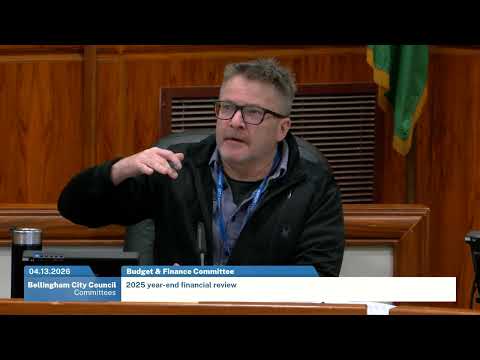
The Bellingham Budget & Finance Committee, chaired for the meeting by Council Member Liiloquist, received a preliminary 2025 year-end financial review that showed citywide revenues of roughly $418 million against expenses of about $472 million and warned that several reserves are thin going into 2026.
City finance staff, presented by Andy, said the 2025 totals are preliminary and unaudited but reflect an overall pattern of flat retail sales-tax collections over the past four years, one-time capital spending and rising service costs that together produced a larger increase in expenses than in revenues. “We ended just above that bar at that sliver of economic reserve,” Andy said, summarizing the general-fund position after several one-time revenue adjustments.
The presentation highlighted three items that shaped 2025 results: a modest increase in revenues from reallocated interest and sales-tax sharing and a fully funded fire pension levy that together added about $8.7 million to the general fund; elevated capital spending (about $106 million actual vs. $220 million budgeted, leaving ~$114 million in planned projects to reappropriate); and rising operating costs such as medical and workers-compensation claims.
Staff told the committee that retail sales-tax — shown as the 1% equivalent in the slides — has been essentially flat, moving from about $32.3 million to $33.6 million over four years, while early 2026 activity shows some growth driven largely by construction and new taxable categories (IT/software, security and live presentations). Lodging-tax receipts were lower in 2025 (about $2.2 million) than in prior years, and border‑crossing counts used to estimate tourism-related activity fell by roughly 2.2 million travelers in 2025 versus 2024, a decline that staff said has reduced overnight‑stay revenue.
Permitting activity showed a large value spike in October 2025 — roughly $177 million — tied to a hospital building permit, and staff said about $120 million in permit value is ‘‘ready to issue’’ and waiting to move forward. Despite the permit‑value spike, housing units tallied for the first quarter of 2026 remained modest (about 135 units), and staff cautioned that unit counts and permit values do not always move in lockstep.
Committee members pressed staff about several operational risks. When asked to explain a “negative estimated ending reserve” for the Medic One fund, Andy said the fund had about $800,000 in bank cash at year end but also had roughly $1.2 million in payments (county ALS/GMT charges and payroll timing) that became due after the year closed, leaving the fund effectively short of cover for those expenses. “It didn't have enough cash to be able to cover those expenses,” Andy said. Committee members were told a contingency loan had kept the fund cash-positive at 12/31 but that Medic One will be an item of continued attention in 2026.
Internal service funds also showed stress: staff reported about $2.5 million more in medical and workers‑comp claims than projected, prompting adjustments to 2026 allocations for the city's self‑insurance programs. The top capital projects in 2025 included multi‑source funded items such as POC phase 2 and a Waccom operations center; staff said many projects will require reappropriation in the coming council meeting.
Council Member Dan asked what drove increases in business-and-occupation (BNO) and utility tax receipts; staff attributed the BNO uptick in part to improved staffing and collection efforts that captured backlog payments and said roughly $700,000 of the utility-tax gain came from higher electricity receipts. Council Member Lisa raised concerns about rising fuel and commodity prices from recent global events, and staff said those impacts lag and would be monitored with midyear amendments if necessary.
Staff told the committee it expects to bring bookkeeping ordinances, reappropriations (about $7 million of needed adjustments) and a revised reserve projection (‘alligator’ graph) to the next council meeting to finalize year‑end accounting and to address shortfalls identified in the preliminary figures. The committee adjourned with members asking for continued monitoring of Medic One, insurance reserves and the pace of capital projects.
The Finance Committee did not take formal votes on policy changes during the presentation; staff emphasized the numbers are preliminary and that audited financial statements and specific ordinances will be presented to the full council for formal action.