Get Full Government Meeting Transcripts, Videos, & Alerts Forever!
Get email alerts on the Accelerated Math Policy topic
No spam. Unsubscribe anytime.
Board hears first read of HB 2686 accelerated-math policy; members press for supports and clear logistics
Summary
Superintendent's staff presented a first reading of the accelerated mathematics policy required by House Bill 2686 (grades 5—8); board members pressed on who will manage placements, how struggling students will be returned to standard classes and what tutoring or staffing supports will be provided.
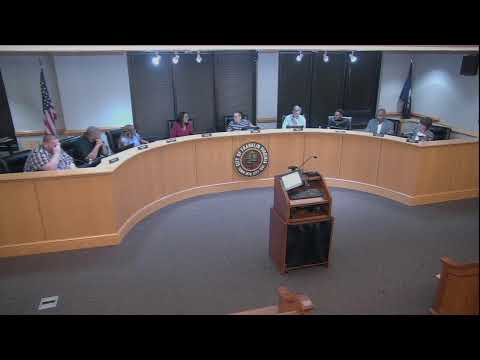
The Franklin City School Board received a first reading on June 4 of the accelerated mathematics policy required by House Bill 2686, which directs divisions to provide specified advanced and accelerated math opportunities for students in grades 5 through 8.
Miss Tomkins (Superintendent-level presenter) told the board that students who meet state criteria — including being in the upper quartile of performance based on last year's scores — will be automatically enrolled in accelerated courses but that the division will use several placement measures beyond a single test score. She said placement decisions will consider final grades (A or B), teacher recommendations, demonstrated mathematical reasoning and parent agreement; parents will be able to opt their children out if they prefer the standard progression.
Tomkins said the division received implementation guidance from the state on May 1, 2026, and plans to identify eligible students from spring test scores, notify parents during the summer and begin implementation in the 2026-27 school year. She said progress monitoring will occur early in the school year and that, if a child is struggling, the division will reconvene teachers and parents and may return the student to the standard course; the goal is to act within weeks rather than wait until the first report card.
Board members urged clearer logistics and supports. Questions included where a student returns if removed from an accelerated class midyear, how the division will avoid disrupting students if classes are already underway, whether teaching assistants will be assigned if sections are consolidated, and what tutoring or remediation will be available. Tomkins acknowledged those operational details remain to be worked out during summer planning and promised to coordinate with principals, teachers and curriculum staff.
Why it matters: House Bill 2686 affects placement and instruction for upper-elementary and middle-school students and shifts some placement decisions into an automatic-enrollment model with parental opt-out and required ongoing progress monitoring. Local implementation raises operational questions (scheduling, staffing, progress monitoring) that the division must resolve before fall enrollment.
Next steps: The policy will return for a second reading and formal adoption at a subsequent board meeting; the division will continue summer planning to finalize placement procedures, parent notification and support systems.