Get Full Government Meeting Transcripts, Videos, & Alerts Forever!
Get email alerts on the Opioid Settlement And Recovery Services topic
No spam. Unsubscribe anytime.
Grace and Mercy asks Hopkinsville for minivan, urges opioid-settlement funding for recovery services
Summary
Representatives of Grace and Mercy told Hopkinsville council they operate without state or federal funds, outlined an 18-month average stay and a reported 11% rearrest rate, and asked the city to consider opioid settlement funds and a six-passenger minivan for client transportation.
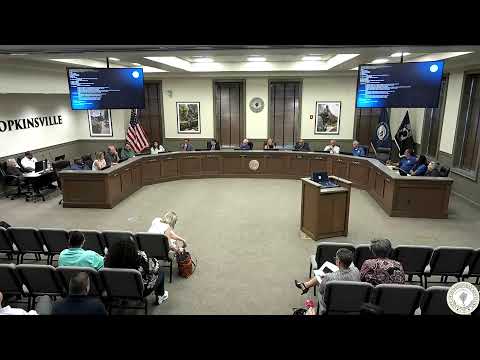
At the June 2 Hopkinsville City Council meeting, Carolyn Self, a founding board member of Grace and Mercy, urged the council to consider awarding opioid settlement funds to support the nonprofit’s residential recovery program for women.
“Grace and Mercy does not receive any state or federal funds. It is totally financed by fundraising and the proceeds from the thrift store and fudge production,” Self said. She described the program’s average stay as 18 months plus one year of aftercare and reported that, over 10 years, the program had more than 80 alumni and a rearrest rate of about 11%.
Self requested the city provide a six-passenger minivan to transport clients to court, probation appointments and medical or dental care that often requires travel outside Hopkinsville. “Transportation then becomes one of our major expenses and one of our biggest problems,” she said.
Sierra Davis, identified in the meeting as the program’s executive director and a Grace and Mercy graduate, gave a personal account of recovery and urged the council to invest in programs that offer wraparound services, housing and long-term support. “Because someone invested in recovery, my children got their mother back,” Davis said.
Mayor James Right Jr. responded that application forms would be provided; the council did not vote on the request. Council later voted to rescind the separate opioid remediation committee (Executive Order 27-2026) and assigned opioid-settlement matters to the committee of the whole, meaning funding decisions will be heard at a future committee meeting.
Self provided program details to the record, including reliance on private fundraising, transportation burdens, and an asserted recidivism metric; the council did not commit funding at the June 2 session.