Get Full Government Meeting Transcripts, Videos, & Alerts Forever!
Get email alerts on the Housing topic
No spam. Unsubscribe anytime.
Council approves rezoning to allow townhomes on Scott Street; nonprofit seeks grant to develop 11 units
Summary
The Common Council unanimously passed Ordinance 27-26 to rezone seven Scott Street parcels from U1 to U2, clearing the way for an 11-unit development the Near Northwest Neighborhood Association plans to build if awarded a Federal Home Loan Bank grant.
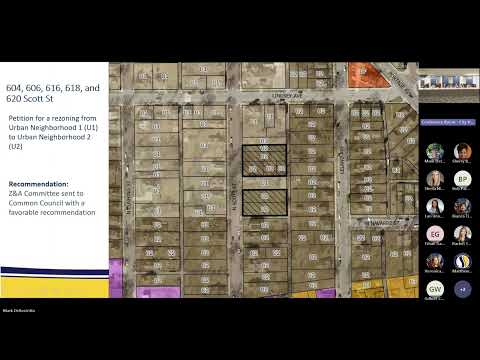
The South Bend Common Council unanimously adopted Ordinance 27-26 to rezone parcels at 604, 606, 616, 618 and 620 Scott Street from Urban Neighborhood 1 (U1) to Urban Neighborhood 2 (U2), enabling townhouse-style triplex building types.
City zoning specialist Mark Delashrito said the parcels are currently vacant but historically contained one- and two-unit dwellings and are surrounded in places by U2 zoning. "A rezoning from U1 to U2 makes sense in this instance," Delashrito said, noting the proposed townhome building type would be contextual in scale with surrounding development.
Kathy Shu, executive director of the Near Northwest Neighborhood Association, described the sites as part of an 11-unit project; the association intends to receive the parcels from the city and develop them if it wins a Federal Home Loan Bank of Indianapolis affordable housing grant. Shu said the association expects to hear whether the application was successful in November and that the city agreement to transfer the land runs through Dec. 31, 2027, allowing a second grant cycle if needed.
Shu said the association plans two triplex buildings on these parcels and that each unit would be sold as fee-simple homes on subdivided lots. She described the homes as two-story, three-bedroom units and said the project aims to create lower-cost for-sale housing in the Near Northwest neighborhood. Council members asked about timelines, ownership structure and whether funding failure would delay the project; Shu told the council the city agreement allows a two-year window and a second application cycle, and that deeds and party-wall arrangements will be clarified prior to sale.
After no members of the public spoke in the hearing, council members moved and the measure passed by recorded vote (nine affirmative votes). The rezoning clears a regulatory hurdle but does not itself commit grant funds or a construction start date.