Get Full Government Meeting Transcripts, Videos, & Alerts Forever!
Get email alerts on the City Budget topic
No spam. Unsubscribe anytime.
Durham council narrows budget gap, tentatively backs partial restoration of partner funding
Summary
At a third budget work session, Durham City Council gave staff direction to blend modest use of reserves and ARPA interest with targeted cuts to one-time items to restore some outside-agency funding, increase immigrant legal defense funding, and avoid a property-tax increase. Final numbers will be returned before the June 15 vote.
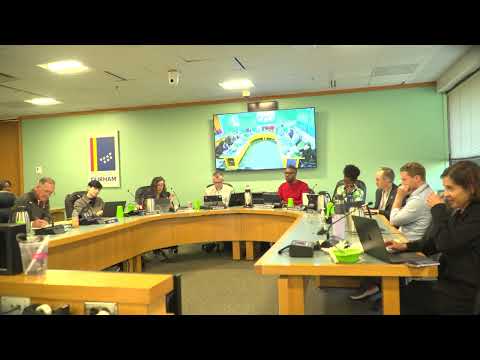
Durham City Council spent a three-hour work session Wednesday narrowing the remaining shortfall in the manager's proposed budget, with members directing staff to develop a blended package that would restore partial outside-agency funding, bolster immigrant legal-defense support, and limit use of reserves rather than raise property taxes.
Christina Rearden, the city's Budget and Management Services Director, told the council the session was intended to finalize remaining reconciliation items before the June 15 adoption and that staff had circulated a follow-up memo answering questions from earlier sessions. Mayor Pro Tem Tim opened the discussion with a synopsis of council's priorities, saying members had expressed interest in returning outside partners to at least 50% of prior funding, funding the Weston Community Center where feasible, and increasing immigrant legal-defense support toward $750,000; he also flagged crossing guards, a parking pilot and continuation of the guaranteed basic-income program as recurring points of interest.
Council members debated tradeoffs across three levers: (1) cutting or delaying onetime requests included in the manager's budget (about $2.2 million of onetime items was cited), (2) drawing from the general-fund balance (council policy floor: 16.7% of operating reserves; staff said the city historically carried closer to 18—20%), and (3) raising revenue via a small property-tax increase. Several members discussed a quarter-penny tax increment as a narrowly targeted way to fund employee bonuses (roughly $500,000), but most said they were not willing to raise property taxes while Durham County is also increasing rates and while seniors and fixed-income residents remain vulnerable.
Members pressed staff for detail on onetime items that could be deferred or reduced. Rearden and finance staff listed the largest candidates: a classification-and-compensation study (~$400,000), community-safety fleet needs (~$400,000), a skid-steer replacement ($175,000), and a $200,000 furniture/fixtures/equipment allocation. Staff noted departments have already absorbed roughly $3.6 million in cuts, so shifting those costs would have programmatic consequences or delay necessary replacements.
Housing and neighborhood services director Sarah Venius briefed the council on the eviction-diversion and rental-assistance systems. She said Legal Aid's eviction-diversion work has opened about 768 cases so far this year and has achieved a roughly 42% success rate in preserving tenancy and avoiding judgments in 73% of handled cases. Venius described structural limits in the county's rental-assistance program (for example, requiring a filing or being at least one month behind), and she said staff plan to coordinate more closely with county partners to improve access.
On the homeless strategic framework, council members split over whether to protect the full-launch funding proposed by the manager or to scale the plan back and cover community partners until the plan ramps up. Several members argued the new strategic framework is ambitious and will require initial investments to succeed; others said modest reductions or use of ARPA interest dollars would be acceptable if they prevent cuts that would create immediate service gaps for clients.
Absent consensus for a tax increase, most council members favored a mixed approach: (a) restore a significant portion of outside-agency funding (a working option discussed was returning agencies to roughly half of requested increases and treating similar partners consistently), (b) shift some one-time requests or delay noncritical purchases, and (c) accept a limited draw on fund balance capped in the low hundreds of thousands (several council members said they could accept up to $500,000). The mayor and budget staff asked for explicit direction so they can prepare a final packet that itemizes all changes from the manager's original proposal.
Council did not take a formal vote at the work session. Instead, members gave staff clear direction to prepare a revised budget package reflecting the preferred mix of restored partner funding, targeted reductions among onetime items, and limited use of ARPA interest or fund balance. Staff committed to produce the math and a memo that will show the final proposed adjustments ahead of the June 15 budget adoption vote.
What to watch next: staff will deliver a memorandum and an updated budget packet that identify the specific onetime items proposed for delay or reduction, the precise dollar amount the council is prepared to draw from fund balance, and the final set of outside agencies to receive partial restoration. The council is scheduled to vote on the budget on June 15.