Get Full Government Meeting Transcripts, Videos, & Alerts Forever!
Get email alerts on the Accreditation Regulation Overview topic
No spam. Unsubscribe anytime.
Education Department proposal sparks debate over keeping Title IV aid during accreditation disputes and over new substantive-change rules
Summary
At a negotiated-rulemaking session, Department staff defended a draft allowing temporary continuation of Title IV aid during accreditor disputes and proposed narrower definitions of 'substantive change'; stakeholders pressed on governance limits, innovation at employer/dual-enrollment sites and the risk to students from ownership changes.
U.S. Department of Education negotiators and accreditation stakeholders spent the afternoon debating several proposed regulatory changes aimed at clarifying when accreditors must approve institutional changes and when the Department can step in to preserve federal student aid.
Jeff Andrade, a Department staff member leading the session, said the rule’s paragraph H is designed to address “the interim period of time” when an accreditor’s action is contested and a court-ordered stay has not yet been obtained. "Right now, we don't have a mechanism to continue Title IV if there's a dispute going on," he said, arguing the provision would cover the gap between an accreditor action and any judicial remedy.
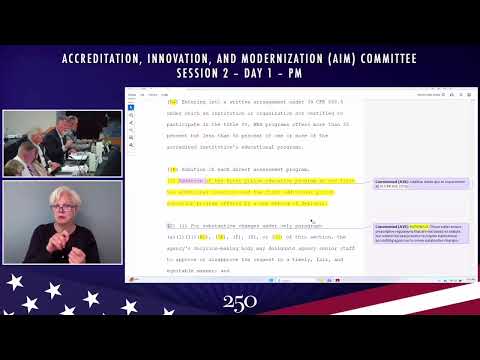
Department staff and Beth Daggett, who walked the group through the substantive-change edits, described a reorganization of items that will be notification-only versus those that still require accreditor approval. Daggett said the draft keeps accreditor approval for prison-education programs and for certain changes that risk program integrity, while allowing notification rather than review for lower-risk items such as written arrangements up to 25 percent under existing 34 CFR 668.5; arrangements above 25 percent but below 50 percent retain closer scrutiny.
Several negotiators challenged portions of the draft. Jennifer Blum said she appreciated some deletions but questioned moving a change of mission into a notification-only category, calling mission changes "fundamental" and arguing they should trigger accreditor review. Monty Sullivan and others warned that tighter notification rules could tie institutions’ hands in delivering employer‑requested instruction and dual-enrollment offerings because FSA (Federal Student Aid) rules drive location review for Title IV purposes; Daggett and Michale McComis (an agency representative) said FSA remains the primary driver of location review but noted some regulatory leeway exists when accreditors have already approved additional sites.
On governance, the Department’s language would defer to state law for public institutions when governance structures (including appointment of directors by elected officials) are established by state statute; some participants worried that broad deference to state law could limit accreditor scrutiny of boards and systems that control academic quality. The draft also codifies that any change in legal status leading to a change of control requires accreditor policies and review, a point staff said strengthens, not weakens, protections for students.
The session did not produce formal votes. Andrade said the Department will continue refining language, and negotiators scheduled caucuses, including a dedicated caucus on transfer-of-credit provisions. The Department plans to circulate revised text after the caucuses for further consideration.