Get Full Government Meeting Transcripts, Videos, & Alerts Forever!
Get email alerts on the Emerald Ash Borer topic
No spam. Unsubscribe anytime.
Maine Forest Service updates towns on emerald ash borer response and hemlock woolly adelgid biocontrol
Summary
State entomologists described recent emerald ash borer detections, urged municipal ash-tree inventories and plans to avoid expensive delayed removal, and summarized releases and early recoveries of tiny specialist parasitoids used as biological control; they cautioned that biocontrol will not save most mature, already-infested trees.
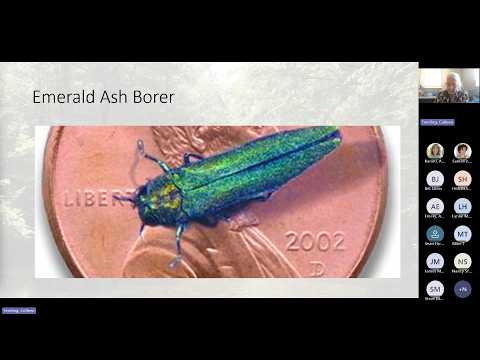
Colleen Tier, a presenter introduced by the Maine Forest Service, told municipal attendees the agency has been tracking emerald ash borer and that a 2026 detection has already been recorded near Stockholm. She urged towns to map their ash trees and put formal management plans in place rather than delay action.
"Having a plan is really critical," Colleen said, explaining that surveys of tree location, counts and health help communities decide which trees to treat and which to remove. She said treatment can cost-effectively spread expenses over time and that injections by licensed pesticide applicators can protect individual trees for multiple years when used appropriately.
Colleen reviewed quarantine and wood‑movement guidance: ash wood and debris can move within regulated areas but generally must not be moved outside quarantined zones without a compliance agreement. She recommended on‑site processing where feasible, or waiting until lower adult emergence risk (after Oct. 1) or seasoning material for 12 months before relocation.
On biological control, Tier described the state strategy of releasing three species of very small, EAB‑specialist parasitoid wasps at seed sites so they can establish and spread to follow EAB as infestations expand. Ideal release sites are forested stands (at least a few acres) with mixed‑age trees and roughly 25% or more ash, she said.
The presenter reported positive recoveries from releases: field surveys in 2025 turned up multiple larval parasitoids at several sites, and one site produced dozens of specimens during monitoring. "We're really encouraged about the establishment of the parasitoids," she said, but added that egg parasitoids remain difficult to detect in surveys.
Colleen cautioned that biological control takes years to affect pest populations and that it will not rescue most mature trees already dying from EAB. She said the state is collaborating with USDA APHIS and university labs on projects to test whether targeted pesticide protection combined with biocontrol can help preserve some ash cohorts over the long term.
The agency will hold an in‑person EAB update focused on management sometime in late spring or early summer; attendees were invited to sign up for updates on the Maine Forest Service website.