Get Full Government Meeting Transcripts, Videos, & Alerts Forever!
Get email alerts on the Zoning topic
No spam. Unsubscribe anytime.
Eastham narrows sign rules, amends inclusionary zoning and refers several zoning articles for rewrite
Summary
At a reconvened Eastham town meeting, voters approved changes to the sign code and an amended inclusionary zoning bylaw designed to ease burdens on small projects, then sent several other zoning articles back to the Zoning Task Force for technical fixes and more public education.
EASTHAM — Voters at a reconvened town meeting on Monday approved changes to local zoning rules, passing an amendment to the sign code and a revised inclusionary zoning bylaw while referring several other zoning proposals back to the Zoning Task Force for additional work.
The meeting’s moderator, Scott Kerry, explained the session reconvened after a quorum question delayed the final votes the previous night. Article 8E, amending the town’s sign regulations, passed first: 245 in the affirmative and 103 in the negative, exceeding the two-thirds threshold required for passage.
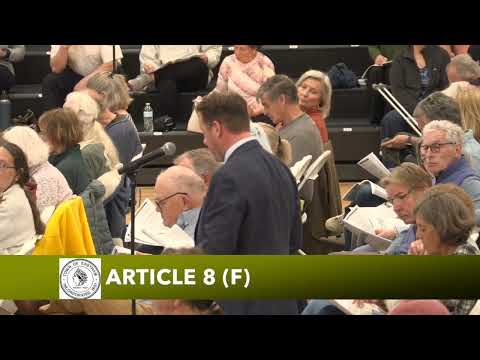
The more detailed debate focused on Article 8F, an amendment to the town’s inclusionary zoning bylaw introduced by Paul Lages, the town planner. Lages said the change is intended to make the bylaw less burdensome for small-scale redevelopment projects by local business owners and to preserve tools for larger developments required under state rules. “What this proposal does is it removes the strict compliance with the state requirements,” Lages said, and replaces them “with options for locally controlled protections to make sure we have the types of housing that work best for our community here in Eastham.” The article passed 339 yes, 41 no.
Residents asked how the amendment would interact with state programs. Paula Asciutino asked whether the change would eliminate the Local Initiative Program tied to Chapter 40B; officials said the town will keep tools that allow larger projects to meet state requirements while giving the planning board and applicants more flexibility for smaller projects. Bridget McKenna asked whether the bylaw still permits off‑site affordable units. A planning representative confirmed off‑site construction remains an option but will be shifted to require a special permit and planning board approval to give the town more control over whether that approach is appropriate.
Several subsequent articles (8G, 8H and 8I) drew prolonged public comment and questions about technical cross‑references — for example, language tied to changes voters made earlier in the meeting. Mary Nee, chair of the Zoning Task Force, told the meeting that rescinded or amended provisions had produced ripple effects across the set of proposed changes and that the task force would debrief and improve public education. Select board members and staff repeatedly said referral would allow the task force another year to correct technical inconsistencies and address contentious items such as fence heights and setbacks.
The motion to refer Article 8G back to the Zoning Task Force passed 312 yes, 69 no. The motions to refer Articles 8H and 8I likewise passed, with votes of 336–41 and 328–42, respectively.
What’s next: The passed amendments will be incorporated into the town’s zoning code and enforced as written. Items referred to the Zoning Task Force will be revisited in the coming year with additional public outreach and technical corrections before being returned for future consideration.
Vote totals and formal motions recorded at the meeting match the town tally as announced from the floor.