Get Full Government Meeting Transcripts, Videos, & Alerts Forever!
Get email alerts on the Wireless Infrastructure topic
No spam. Unsubscribe anytime.
Crown Castle proposes 189 small-cell sites in East Hampton; planning staff, board and residents raise aesthetics and permitting questions
Summary
Crown Castle presented a tier-one small-cell program anchored by T-Mobile with about 189 proposed nodes (129 targeted to be on air by late 2025). Planning staff said the work follows the town's 2024 wireless master plan; the board emphasized stealth design, flood-zone review and local context for pole placement.
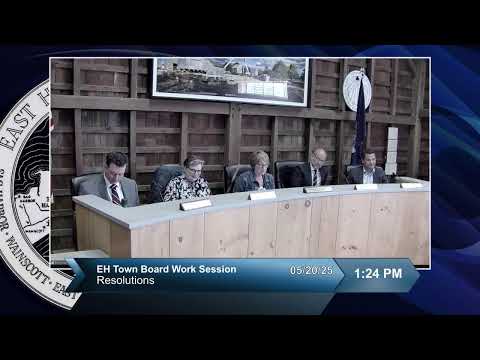
Crown Castle representatives briefed the East Hampton Town Board on May 20 about a planned small-cell deployment intended to fill coverage gaps identified in the town's 2024 Wireless Telecommunications Master Plan.
Tina Loger (planning staff) framed the presentation: "We updated the code in 2022 and issued a wireless master plan in April 2024 to balance service improvements with community character," she said. The town's approach uses a three-tier structure: tier one (small cells in the right-of-way, administrative permits), tier two (collocations) and tier three (new macro towers requiring public review).
Paul (recorded as Paul Cas), Crown Castle's network-permitting manager, said the company designed about 100 new poles (with 18 attachments to existing utility poles; additional designs pending) and presented two broad concealment approaches: ground-concealment bases that hide equipment at pole bases, and integrated metal shrouds that enclose equipment in a slimmer pole profile. "Our shrouds are designed to hold two to three carriers," Paul said, adding that T-Mobile is the anchor tenant for the initial build.
Paul gave a deployment timeline: fiber construction has begun, Crown Castle expects to submit initial permit applications "relatively soon," and the company aims to have roughly 129 sites on air by NovemberDecember 2025, with the remainder built in 20262027. Paul said the range of a small-cell site is roughly 500 to 1,000 feet and that many carrier needs are coverage-driven; collocation by additional carriers is expected once sites are live.
Board members and staff pressed on technical and local concerns. Questions included whether the new nodes increase interior as well as in-vehicle coverage (Crown Castle said they improve outside coverage and can help interior coverage depending on location and walls), how emergency calls from non-T-Mobile phones would route through the nodes (Paul said he believed 911 traffic would work across carriers but promised to confirm), utility attachment rules (some poles are ineligible where transformers or risers create clearance conflicts), and the resiliency of ground-level cabinets in flood-prone locations.
Planning staff and the town's consultant (Susan from Cityscape) emphasized the administrative-review path for tier-one installations: applications receive a technical review and a design/aesthetic review but do not require planning-board hearings under the code. Tina and Eric said the department will assess each proposed site and work with Crown Castle to prefer stealth options in visually sensitive areas; the board urged priority for base-concealment designs where feasible and asked staff to ensure flood-zone and emergency-access constraints are considered.
No permits were approved at the meeting; planning staff said they will accept the formal applications and process them under the updated administrative permit rules while continuing to gather board feedback on preferred designs.
Next steps: Crown Castle will submit batched permit applications; planning staff (with Cityscape) will review for technical completeness and design context; the board and staff will continue community outreach about proposed site designs and locations.