Get Full Government Meeting Transcripts, Videos, & Alerts Forever!
Get email alerts on the Stormwater Beckingham topic
No spam. Unsubscribe anytime.
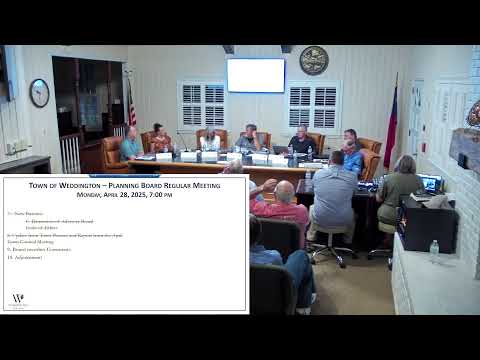
Weddington planning board recommends council approve Beckingham zoning amendment with stormwater conditions after heated debate
Summary
After residents raised flood and tree-loss concerns, the planning board approved a recommendation (5–1) that Town Council allow the Beckingham subdivision to drop three detention ponds in favor of low-impact controls — provided developers notify affected property owners and secure a maintenance agreement for a clogged culvert area.
The Weddington Town Planning Board voted 5–1 on April 28 to recommend that Town Council approve a conditional-zoning amendment for the Beckingham subdivision that would let the developer replace three approved stormwater ponds with low-impact measures — if the developer meets specific conditions to protect downstream property.
The proposal, from Provident Land Services, asks the town to waive a UDO stormwater requirement in Appendix 8 (§58-543B1) that generally requires major residential developments to control peak runoff to predevelopment rates for the 10-, 25- and 100-year storms. Supporters say the state’s low-impact approach applies because the site’s post-development impervious area is below state thresholds; opponents warned the change risks additional downstream flooding, dam impacts and permanent loss of mature trees.
Residents and homeowners’ associations pressed the board during public comment. “None of the storm water runoff from Beckingham will go into our pond,” said Cammy Merritt of Lock Haven, describing a 2020 overtopping event and saying silt has reduced her pond’s capacity and increased breach risk. Chad Emerine, representing the Arrow Plantation homeowners association, urged the board not to recommend the waiver, saying the original approved plan included three ponds, that the community had been told all runoff would be captured in those ponds, and that additional downstream volume could increase dam-repair costs and failure risk.
Developer Tom Waters (Provident Land) said the state review found the site’s impervious cover at about 19% — below the state’s 24% threshold for low-impact design — and that the state advised ponds were unnecessary. Waters told the board the team would legally commit to capping impervious coverage at 19%, use panel-block septic systems and install level spreaders, rain-harvesting systems on homes, double silt fencing during construction and third-party erosion inspections. He said the redesign also reduced lots from 38 to 36 and shortened cul-de-sacs to reduce grading and tree loss.
An independent downstream review by Labella Associates’ senior engineer Bob Wilson, commissioned at the board’s request, found mixed results: the larger Monday’s Run tributary (FEMA-regulated) showed little impact, but a smaller tributary that receives a larger proportion of on-site runoff could see peak-discharge increases of roughly 30% (10-year), 23% (25-year) and 17% (100-year). Wilson reported a modeled 1.99-foot rise in water-surface elevation at a Hidden Haven Trail culvert in the 100-year scenario and recommended notifying affected property owners in writing and conducting follow-up analyses for mitigation.
Board members questioned model assumptions (including the effect of a clogged 30-inch culvert at Hidden Haven), whether level spreaders were accounted for in the analysis, and how long-term maintenance would be assured if the town accepts an alternative stormwater approach. Staff explained that state DEQ low-impact rules focus on water quality and impervious-area thresholds, while Weddington’s UDO includes quantity controls (10/25/100-year events).
Before voting, the board discussed and then attached conditions recommended by staff and Labella: that the developer (1) send written notice to all property owners affected by the change, describing modeled changes in flows and water-surface elevation and (2) have their engineer evaluate the Hidden Haven culvert and reach a written agreement with the private-property owner of parcel 06-153-053 to allow necessary maintenance (or provide an engineered alternative). The board’s motion framed these items as conditions to be incorporated in the conditional-zoning amendment forwarded to Town Council.
The planning board’s recommendation does not itself change zoning; it forwards the conditional amendment and the board’s conditions to Town Council for final action. Town Council will decide whether to adopt, amend or reject the recommended conditional zoning at a later hearing.
The board also emphasized inspection and bonding: staff said stormwater devices are typically bonded and turned over to an HOA once proven functional, and the ordinance’s “sinking fund” concept would require developer seed funding (15%) and staged HOA funding to ensure long-term maintenance.
Next step: the item will be on Town Council’s agenda; the council review is the final decision point for the proposed amendment to CZ-2023-02.